# Configure TIP for a SAML provider
Use this page to configure TIP for a new or existing SAML provider. First, complete the prerequisites and planning steps in [Before you configure TIP](id_roles_providers_tip_federation_configure.md#id_roles_providers_tip_federation_configure_before).
## Configure TIP when creating a SAML provider
### Amazon Management Console
**To configure TIP when creating a SAML provider (console)**
1. Open the IAM console and choose **Identity providers**.
1. Choose **Add provider**, and then choose **SAML** for **Provider type**.
1. Enter a **Provider name** and upload the SAML **Metadata document**.
1. In **Trusted identity propagation - optional**, **Configure trusted identity propagation** is selected by default. Keep it selected to configure TIP, or clear it to create the provider without TIP.
1. Under **Start from a template**, choose one way to begin:
+ Choose an available identity provider template to start with suggested mappings for fields commonly provided by that identity provider. You can edit or replace any suggested mapping.
+ Choose **Custom** to configure the mappings yourself.
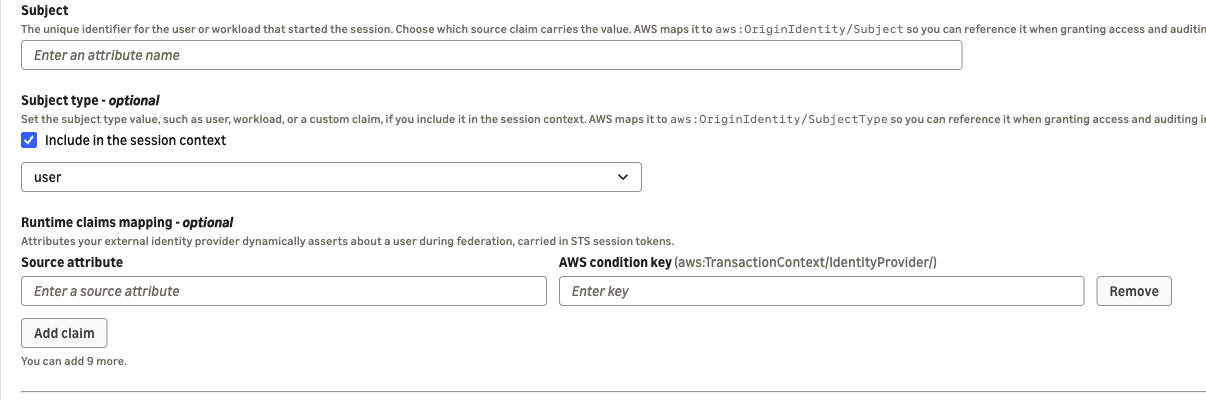
1. For **Subject**, choose one assertion source that identifies the human user or workload. The available sources depend on the template selected in the previous step:
+ From the template-provided sources, choose the field that best represents the human user or workload. We recommend **Subject/NameID (sub)**, which uses the SAML Subject.
+ Choose **Custom SAML attribute** to use another SAML attribute. In **Enter an attribute name**, enter the exact attribute name from the SAML assertion. The attribute must contain one value.
The selected source must be present in the SAML assertion. If it is absent, the federation API request fails. TIP attaches the selected value to the `aws:OriginIdentity/Subject` key.
The IAM console requires a Subject source. If you submit the form with the Subject empty, the console displays **Subject is required.** and does not save the configuration.
1. Under **Subject type - optional**, keep **Include in the session context** selected to attach a Subject type, or clear it to omit the Subject type. If selected, choose how to identify the originator as a human user or workload. TIP attaches this value to the `aws:OriginIdentity/SubjectType` key. Amazon services can use this key for access control decisions and auditability. There are two ways to configure the value:
+ To apply a fixed value to every federated session, choose **user** or **workload**.
+ To derive the value from the SAML assertion, choose **Custom attribute from your SAML assertion**. In **Enter a claim key**, enter a field whose value is `user` or `workload`.
If you choose the custom option but leave **Enter a claim key** empty, the console displays **Subject type is required.** and does not save the configuration.
1. To propagate additional context about the federation session, you can configure optional runtime-claim mappings. Under **Runtime claims mapping - optional**, choose **Add claim** for each SAML attribute you want to carry in the session. Each attribute must contain one value. You can add up to 10 mappings:
+ For **Source attribute**, choose a listed source or **Custom SAML attribute**.
+ For **Amazon condition key (aws:TransactionContext/IdentityProvider/)**, enter the target-key suffix in **Enter key**, or leave it empty to use the source attribute name as the suffix.
+ To delete an unsaved mapping, choose **Remove**.
+ If a row has no source attribute when you submit the form, the console displays **Source attribute is required.** and does not save the configuration.
Select identity context appropriate for your authorization and audit requirements. Before saving the mappings, review [Logging TIP activity with Amazon CloudTrail](id_roles_providers_tip_cloudtrail.md) to understand how selected TIP context appears in CloudTrail events, which customer account receives each event, and how governance controls prevent the context from being logged to unapproved destinations.
Before saving, confirm that each configured source value, source key, and target-key suffix meets the [source-value requirements](id_roles_providers_tip_federation_context_keys.md#id_roles_providers_tip_federation_context_keys_meet_source_value_requirements) and [key requirements](id_roles_providers_tip_federation_context_keys.md#id_roles_providers_tip_federation_context_keys_map_identity_provider_runtime_claims).
1. Under **Support group-based access for users**, select **Allow granting permissions to groups** if your use case requires access based on a human user's group membership. The console hides this section when **Subject type** is fixed to `workload`.
Complete the applicable instance-selection or instance-creation path in [Configure group-based access for TIP](id_roles_providers_tip_federation_configure_group_access.md#id_roles_providers_tip_federation_configure_group_access-choose-the-iam-identity-center-setup-path).

1. Complete any optional settings, and then choose **Add provider** to create the provider and save its TIP configuration.
1. [Verify the saved TIP configuration](#id_roles_providers_tip_federation_configure_saml-verify-the-tip-configuration).
For standard SAML provider fields and optional SAML encryption settings, see [Create a SAML identity provider in IAM](id_roles_providers_create_saml.md).
### Create using the Amazon CLI or Amazon SDK
To create a SAML provider with TIP programmatically, call the public [`CreateSAMLProvider`](https://docs.amazonaws.cn/IAM/latest/APIReference/API_CreateSAMLProvider.html) API. Use [`aws iam create-saml-provider`](https://docs.amazonaws.cn/cli/latest/reference/iam/create-saml-provider.html) with the Amazon CLI or [`create_saml_provider`](https://boto3.amazonaws.com/v1/documentation/api/latest/reference/services/iam/client/create_saml_provider.html) with the Amazon SDK for Python.
The request includes the existing `Name` and `SAMLMetadataDocument` parameters for the SAML provider. To configure TIP, include the `ContextProvider` parameter. If you need group-based access, also provide the ARN of the IAM Identity Center instance through the optional `IdentityCenterInstanceArn` parameter.
Amazon CLI and SDK requests do not apply the console's identity provider templates or defaults, so you must define the TIP mappings explicitly. `ContextProvider` is the TIP mapping configuration for the IAM identity provider. When `AssumeRoleWithSAML` succeeds, Amazon STS uses these mappings to attach selected fields and attributes from the verified SAML assertion to the resulting role session.
`ContextProvider` contains the following settings:
+ **Subject:** `SubjectSourceKey` identifies the SAML assertion field whose value becomes `aws:OriginIdentity/Subject`. This setting is required. The example uses `sub`, the API value for `Subject/NameID`.
+ **Subject type:** `SubjectTypeValue` supplies a fixed value, or `SubjectTypeSourceKey` identifies a SAML assertion source field or attribute that supplies the value. This setting is optional. Use one member, not both. The value must be `user` or `workload`.
+ **Runtime claims:** `KeyDefinitionList` optionally maps additional assertion values. In each mapping, `SourceKey` identifies the source field or attribute and `TargetKey` is appended to `aws:TransactionContext/IdentityProvider/` to form the condition key.
Some source-key values select standard SAML assertion fields rather than custom attributes. The following table shows these reserved values and the assertion source that each value selects.
| Source-key value | SAML assertion source |
| --- | --- |
| sub | Subject/NameID value |
| sub\_type | Subject/NameID Format URI |
| iss | Assertion Issuer element |
| iat | Assertion IssueInstant |
| nbf | Conditions NotBefore |
| exp | Conditions NotOnOrAfter |
| acr | AuthnContextClassRef URI |
| auth\_time | AuthnStatement AuthnInstant |
These reserved source-key values are case-sensitive. For example, `sub` selects the SAML `Subject/NameID`, while `SUB` selects a custom SAML attribute named `SUB`.
These source-key values are reserved. If the SAML assertion contains an `AttributeStatement` attribute with one of these names, Amazon ignores that attribute and uses the corresponding standard assertion field. Use a different name for a custom SAML attribute.
The `sub_type` source contains the `Subject/NameID` Format URI. It does not contain the TIP Subject type value, which must be `user` or `workload`.
Every configured source key and target-key suffix must meet the [key requirements](id_roles_providers_tip_federation_context_keys.md#id_roles_providers_tip_federation_context_keys_map_identity_provider_runtime_claims).
Each configured source must contain one valid value. For the supported value types, length, characters, and failure behavior, see [Source-value requirements](id_roles_providers_tip_federation_context_keys.md#id_roles_providers_tip_federation_context_keys_meet_source_value_requirements).
Follow these steps to create the SAML provider and save its TIP configuration using the Amazon CLI or Amazon SDK:
**To configure TIP when creating a SAML provider (Amazon CLI or Amazon SDK for Python)**
1. **Define the TIP mappings.** The following example maps `Subject/NameID` to the Subject, derives the Subject type from the `principalType` assertion attribute, and maps the example `department` runtime attribute.
```json
{
"SubjectSourceKey": "sub",
"SubjectTypeSourceKey": "principalType",
"KeyDefinitionList": [
{
"SourceKey": "department",
"TargetKey": "department"
}
]
}
```
To apply one Subject type to every session, replace `SubjectTypeSourceKey` with `SubjectTypeValue` set to `user` or `workload`. Do not include both members.
Replace `principalType` and `department` with attributes that your identity provider includes in its SAML assertions. The Subject type source must resolve to `user` or `workload`.
1. **Prepare group-based access, if needed.** Obtain the applicable IAM Identity Center instance ARN by following [Choose the IAM Identity Center setup path](id_roles_providers_tip_federation_configure_group_access.md#id_roles_providers_tip_federation_configure_group_access-choose-the-iam-identity-center-setup-path).
Pass `IdentityCenterInstanceArn` at the top level of the same `CreateSAMLProvider` request. This parameter associates the SAML provider with the IAM Identity Center instance used for group resolution.
1. **Create the provider.** Use either the Amazon CLI or the Amazon SDK for Python.
**Amazon CLI**
Save the JSON from step 1 as `context-provider.json`. This example includes group-based access. If you do not need it, omit `IDC_INSTANCE_ARN` and `--identity-center-instance-arn`.
```bash
IDC_INSTANCE_ARN="arn:aws:sso:::instance/ssoins-0123456789abcdef"
SAML_PROVIDER_ARN=$(aws iam create-saml-provider \
--name ExampleProvider \
--saml-metadata-document file://saml-metadata.xml \
--context-provider file://context-provider.json \
--identity-center-instance-arn "$IDC_INSTANCE_ARN" \
--query 'SAMLProviderArn' \
--output text)
printf '%s\n' "$SAML_PROVIDER_ARN"
```
A successful request prints:
```
arn:aws:iam::123456789012:saml-provider/ExampleProvider
```
**Amazon SDK for Python (Boto3)**
Define the same `ContextProvider` mappings as a Python dictionary. This example includes group-based access. If you do not need it, omit `IdentityCenterInstanceArn`.
```python
from pathlib import Path
import boto3
iam = boto3.client("iam")
context_provider = {
"SubjectSourceKey": "sub",
"SubjectTypeSourceKey": "principalType",
"KeyDefinitionList": [
{
"SourceKey": "department",
"TargetKey": "department",
}
],
}
metadata = Path("saml-metadata.xml").read_text(encoding="utf-8")
response = iam.create_saml_provider(
Name="ExampleProvider",
SAMLMetadataDocument=metadata,
ContextProvider=context_provider,
IdentityCenterInstanceArn=(
"arn:aws:sso:::instance/ssoins-0123456789abcdef"
),
)
saml_provider_arn = response["SAMLProviderArn"]
print({"SAMLProviderArn": saml_provider_arn})
```
A successful response includes:
```
{'SAMLProviderArn': 'arn:aws:iam::123456789012:saml-provider/ExampleProvider'}
```
1. **Retain the provider ARN.** The `SAMLProviderArn` response element contains the ARN of the new provider. The create API operation does not return the saved TIP configuration or TIP status.
1. **Verify the TIP configuration.** Follow the [verification procedure](#id_roles_providers_tip_federation_configure_saml-verify-the-tip-configuration).
## Add TIP to an existing SAML provider
### Amazon Management Console
**To add TIP to an existing SAML provider (console)**
1. In the IAM console, choose **Identity providers**, and then choose the SAML provider for which you want to enable TIP.
1. Choose the **Identity propagation** tab. Check **Propagation status**. A value of **Not configured** means that you can continue with this procedure. A value of **Configured** means that TIP is already configured for the provider.
1. Choose **Configure**.
1. Configure the template, Subject, optional Subject type, runtime claims, and optional group-based access as described under [Configure TIP when creating a SAML provider](#id_roles_providers_tip_federation_configure_saml-configure-tip-when-creating-a-saml-provider), beginning with **Start from a template**. The console hides **Support group-based access for users** when **Subject type** is fixed to `workload`.
1. Choose **Configure** to save the configuration.
1. [Verify the saved TIP configuration](#id_roles_providers_tip_federation_configure_saml-verify-the-tip-configuration).
### Add TIP using the Amazon CLI or Amazon SDK
To add TIP to an existing SAML provider, call the public [`UpdateSAMLProvider`](https://docs.amazonaws.cn/IAM/latest/APIReference/API_UpdateSAMLProvider.html) API operation. Every API request includes the required `SAMLProviderArn` request parameter, which identifies the provider to update.
IAM does not accept `ContextProvider` and `IdentityCenterInstanceArn` in the same `UpdateSAMLProvider` request. Submit them in separate requests. The following sequence saves the TIP mappings first. Wait for the `ContextProvider` request to succeed, and then submit a second request with `IdentityCenterInstanceArn` to configure group-based access.
Prepare the complete `ContextProvider` configuration described in the creation procedure.
#### Amazon CLI
Use the [`aws iam update-saml-provider`](https://docs.amazonaws.cn/cli/latest/reference/iam/update-saml-provider.html) Amazon CLI command. Save the `ContextProvider` configuration as `context-provider.json`.
```bash
aws iam update-saml-provider \
--saml-provider-arn "$SAML_PROVIDER_ARN" \
--context-provider file://context-provider.json
```
If you require group-based access, wait for the first command to succeed, and then run:
```bash
aws iam update-saml-provider \
--saml-provider-arn "$SAML_PROVIDER_ARN" \
--identity-center-instance-arn "$IDC_INSTANCE_ARN"
```
#### Amazon SDK for Python (Boto3)
Use the [`update_saml_provider`](https://boto3.amazonaws.com/v1/documentation/api/latest/reference/services/iam/client/update_saml_provider.html) Amazon SDK for Python method. Define the `ContextProvider` configuration in the `context_provider` dictionary.
```python
import boto3
iam = boto3.client("iam")
saml_provider_arn = "arn:aws:iam::123456789012:saml-provider/ExampleProvider"
context_provider = {
"SubjectSourceKey": "sub",
"SubjectTypeSourceKey": "principalType",
"KeyDefinitionList": [
{
"SourceKey": "department",
"TargetKey": "department",
}
],
}
iam.update_saml_provider(
SAMLProviderArn=saml_provider_arn,
ContextProvider=context_provider,
)
# Run this second API request only after the first request succeeds.
iam.update_saml_provider(
SAMLProviderArn=saml_provider_arn,
IdentityCenterInstanceArn=(
"arn:aws:sso:::instance/ssoins-0123456789abcdef"
),
)
```
Omit the second API request when group-based access is not required. Then [verify the saved TIP configuration](#id_roles_providers_tip_federation_configure_saml-verify-the-tip-configuration).
## Change TIP configuration for a SAML provider
Use this section to change the saved Subject, optional Subject type, runtime-claim mappings, or group-based-access configuration for a SAML provider.
### Amazon Management Console
**To change TIP configuration for a SAML provider (console)**
1. In the IAM console, choose **Identity providers**, and then choose the SAML provider whose TIP configuration you want to change.
1. Choose the **Identity propagation** tab and verify that **Propagation status** is **Configured**. A value of **Not configured** means that TIP is not configured for the provider.
1. Choose **Edit**.
1. Update the saved Subject source, optional Subject type, or runtime-claim mappings. The edit flow displays the saved mappings instead of applying an identity provider template.
1. To change group-based access or the associated IAM Identity Center instance, follow [Change or remove group-based access](id_roles_providers_tip_federation_configure_group_access.md#id_roles_providers_tip_federation_configure_group_access-change-or-remove-group-based-access). The console hides **Support group-based access for users** when **Subject type** is fixed to `workload`.
1. Choose **Save changes**.
1. [Verify the saved TIP configuration](#id_roles_providers_tip_federation_configure_saml-verify-the-tip-configuration).
### Change using the `UpdateSAMLProvider` API
To change TIP programmatically, call the public [`UpdateSAMLProvider`](https://docs.amazonaws.cn/IAM/latest/APIReference/API_UpdateSAMLProvider.html) API operation. Every API request must include the required `SAMLProviderArn` request parameter, which identifies the provider to update.
The request parameters fall into two categories. The following table shows the parameters that you can submit together. You cannot combine parameters from different rows.
| What the API request updates | Request parameters that can be submitted together |
| --- | --- |
| SAML provider settings, encryption, and group-based access | SAMLMetadataDocument, AssertionEncryptionMode, AddPrivateKey, RemovePrivateKey, and either IdentityCenterInstanceArn or RemoveIdentityCenterInstance |
| TIP mappings | Either ContextProvider or RemoveContextProvider |
An API request cannot include both `ContextProvider` and `RemoveContextProvider`. IAM returns `ValidationError` for that combination.
IAM rejects an API request that combines parameters from different rows with `InvalidInput`. A single `UpdateSAMLProvider` request can change the context provider or the SAML provider settings, but not both. Wait for each API request to succeed before submitting the next request.
`IdentityCenterInstanceArn` requires the provider to have a saved `ContextProvider`. IAM rejects the association request if TIP is not configured. `RemoveIdentityCenterInstance` does not require an existing association and is accepted when no association exists.
#### Example: Change TIP mappings with related SAML provider settings
The following example demonstrates this requirement by changing the TIP mappings, SAML metadata document, and associated IAM Identity Center instance through two API requests. First, it saves the TIP mappings through the `ContextProvider` request parameter. After that API request succeeds, it submits the `SAMLMetadataDocument` and `IdentityCenterInstanceArn` request parameters together. If your workflow changes only TIP mappings, submit only the first API request.
Before submitting the TIP mapping API request, prepare the complete `ContextProvider` configuration that you want to save.
##### Amazon CLI
Use the [`aws iam update-saml-provider`](https://docs.amazonaws.cn/cli/latest/reference/iam/update-saml-provider.html) Amazon CLI command. Save the complete `ContextProvider` configuration as `context-provider.json`.
```bash
NEW_IDC_INSTANCE_ARN="arn:aws:sso:::instance/ssoins-0123456789abcdef"
# First, change the TIP mappings.
aws iam update-saml-provider \
--saml-provider-arn "$SAML_PROVIDER_ARN" \
--context-provider file://context-provider.json
# After the TIP mapping request succeeds, change the SAML metadata
# and associate the IAM Identity Center instance.
aws iam update-saml-provider \
--saml-provider-arn "$SAML_PROVIDER_ARN" \
--saml-metadata-document file://saml-metadata.xml \
--identity-center-instance-arn "$NEW_IDC_INSTANCE_ARN"
```
##### Amazon SDK for Python (Boto3)
Use the [`update_saml_provider`](https://boto3.amazonaws.com/v1/documentation/api/latest/reference/services/iam/client/update_saml_provider.html) Amazon SDK for Python method. Define the complete `ContextProvider` configuration in the `context_provider` dictionary.
```python
from pathlib import Path
import boto3
iam = boto3.client("iam")
saml_provider_arn = "arn:aws:iam::123456789012:saml-provider/ExampleProvider"
new_instance_arn = (
"arn:aws:sso:::instance/ssoins-0123456789abcdef"
)
context_provider = {
"SubjectSourceKey": "sub",
"SubjectTypeSourceKey": "principalType",
"KeyDefinitionList": [
{
"SourceKey": "department",
"TargetKey": "department",
}
],
}
metadata = Path("saml-metadata.xml").read_text(encoding="utf-8")
# First, change the TIP mappings.
iam.update_saml_provider(
SAMLProviderArn=saml_provider_arn,
ContextProvider=context_provider,
)
# After the TIP mapping request succeeds, change the SAML metadata
# and associate the IAM Identity Center instance.
iam.update_saml_provider(
SAMLProviderArn=saml_provider_arn,
SAMLMetadataDocument=metadata,
IdentityCenterInstanceArn=new_instance_arn,
)
```
For standard SAML metadata requirements, see [Create a SAML identity provider in IAM](id_roles_providers_create_saml.md).
#### If you remove group-based access while changing TIP mappings
If the workflow removes group-based access instead of associating an IAM Identity Center instance, reverse the order. First follow [Remove group-based access](id_roles_providers_tip_federation_configure_group_access.md#id_roles_providers_tip_federation_configure_group_access-remove-group-based-access) to submit the `RemoveIdentityCenterInstance` Boolean request parameter set to `true`. You can include the `SAMLMetadataDocument` request parameter in the same API request. After that API request succeeds, submit the revised `ContextProvider` request parameter.
This order removes group-based access before changing the TIP mappings.
After all applicable API requests succeed, [verify the saved TIP configuration](#id_roles_providers_tip_federation_configure_saml-verify-the-tip-configuration).
Each submitted `ContextProvider` replaces the complete saved `ContextProvider` structure. Include the Subject, optional Subject type, and every runtime-claim mapping that you want to retain. IAM removes optional members and mappings that are omitted from the submitted structure.
## Verify the TIP configuration
Creating or updating a SAML provider returns the provider ARN, but it does not return the saved TIP mappings or enabled status. Verify that TIP is enabled and that IAM saved the intended `ContextProvider` configuration. You can verify these results in the IAM console or programmatically by using the [`GetSAMLProvider`](https://docs.amazonaws.cn/IAM/latest/APIReference/API_GetSAMLProvider.html) and [`ListSAMLProviders`](https://docs.amazonaws.cn/IAM/latest/APIReference/API_ListSAMLProviders.html) API operations.
### Amazon Management Console
**To verify the TIP configuration (console)**
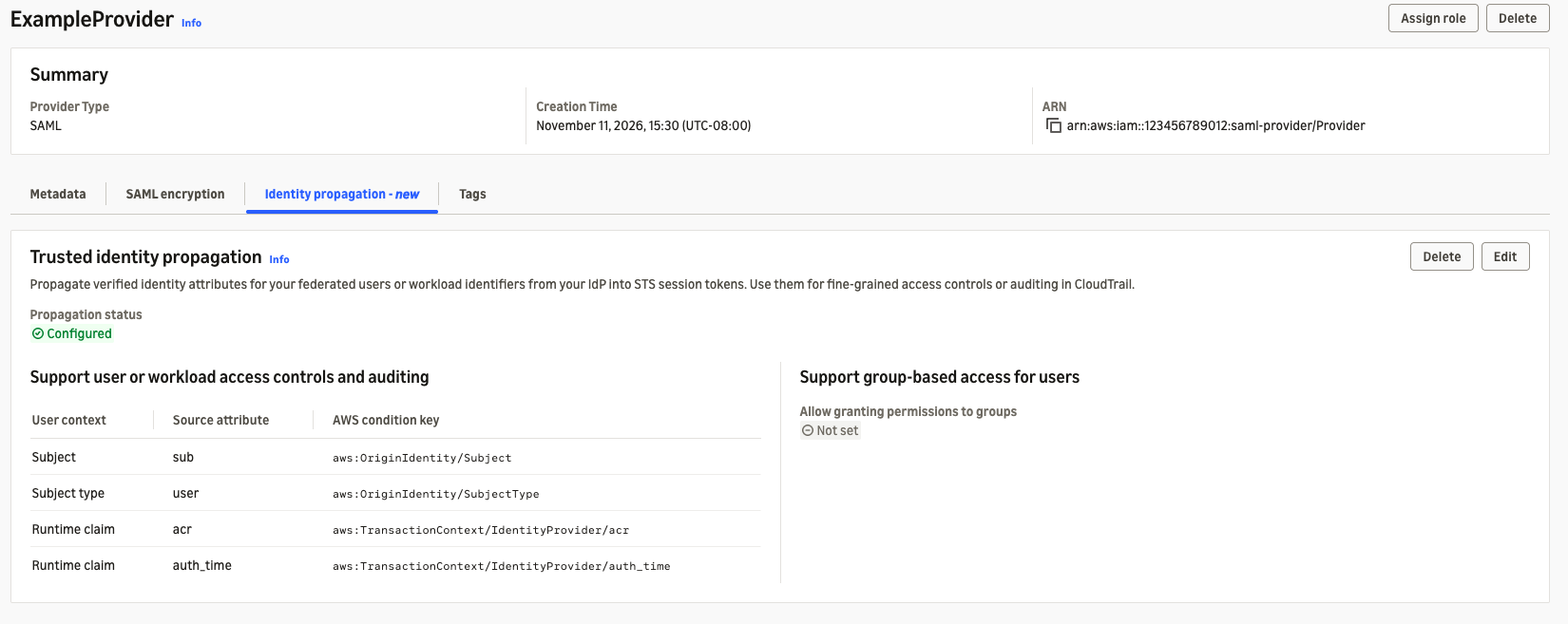
1. In the IAM console, choose **Identity providers**, choose the SAML provider, and then choose **Identity propagation**.
1. Check **Propagation status**. The expected value is **Configured**. A value of **Not configured** means that TIP is not configured.
1. In **Support user or workload access controls and auditing**, compare the displayed Subject source, optional Subject type, and each runtime-claim source and target with the values that you saved.
1. If a TIP value is missing or different, choose **Edit**, correct the configuration, save it, and repeat these checks.
1. If you configured group-based access, confirm that **Connected IAM Identity Center instance** shows the intended instance. Then follow [Verify group-based access](id_roles_providers_tip_federation_configure_group_access.md#id_roles_providers_tip_federation_configure_group_access-verify-group-based-access).
### Amazon CLI
First, use the [`aws iam list-saml-providers`](https://docs.amazonaws.cn/cli/latest/reference/iam/list-saml-providers.html) Amazon CLI command to confirm that TIP is enabled:
```bash
aws iam list-saml-providers \
--query "SAMLProviderList[?Arn=='${SAML_PROVIDER_ARN}'].{TIPEnabled:IsTrustedIdentityPropagationEnabled}" \
--output json
```
The query displays the `IsTrustedIdentityPropagationEnabled` response element using the shorter output label `TIPEnabled`. An enabled provider returns:
```json
[
{
"TIPEnabled": true
}
]
```
A value of `false` means that the provider exists but TIP is disabled. An empty array (`[]`) means that no provider matched `SAML_PROVIDER_ARN`.
Next, use the [`aws iam get-saml-provider`](https://docs.amazonaws.cn/cli/latest/reference/iam/get-saml-provider.html) Amazon CLI command to retrieve the saved `ContextProvider` response element without returning the complete SAML metadata document:
```bash
aws iam get-saml-provider \
--saml-provider-arn "$SAML_PROVIDER_ARN" \
--query 'ContextProvider' \
--output json
```
For the example created earlier, the expected response is:
```json
{
"SubjectSourceKey": "sub",
"SubjectTypeSourceKey": "principalType",
"KeyDefinitionList": [
{
"SourceKey": "department",
"TargetKey": "department"
}
]
}
```
Use the response to verify the saved configuration:
+ `SubjectSourceKey` must equal `sub`.
+ `SubjectTypeSourceKey` must equal `principalType`.
+ `KeyDefinitionList` must contain the `department` source-to-target mapping from the request.
A missing or different member means that the saved TIP configuration does not match the request.
If you configured group-based access, also follow [Verify group-based access](id_roles_providers_tip_federation_configure_group_access.md#id_roles_providers_tip_federation_configure_group_access-verify-group-based-access).
### Amazon SDK for Python (Boto3)
Use the [`get_saml_provider`](https://boto3.amazonaws.com/v1/documentation/api/latest/reference/services/iam/client/get_saml_provider.html) and [`list_saml_providers`](https://boto3.amazonaws.com/v1/documentation/api/latest/reference/services/iam/client/list_saml_providers.html) Amazon SDK for Python methods:
```python
import boto3
iam = boto3.client("iam")
saml_provider_arn = "arn:aws:iam::123456789012:saml-provider/ExampleProvider"
saved = iam.get_saml_provider(SAMLProviderArn=saml_provider_arn)
provider = next(
(
item
for item in iam.list_saml_providers()["SAMLProviderList"]
if item["Arn"] == saml_provider_arn
),
{},
)
result = {
"ContextProvider": saved.get("ContextProvider"),
"TIPEnabled": provider.get("IsTrustedIdentityPropagationEnabled"),
}
print(result)
```
For the example created earlier, the expected output is:
```
{'ContextProvider': {'SubjectSourceKey': 'sub', 'SubjectTypeSourceKey': 'principalType', 'KeyDefinitionList': [{'SourceKey': 'department', 'TargetKey': 'department'}]}, 'TIPEnabled': True}
```
`ContextProvider` must match the Subject, optional Subject type, and runtime-claim mappings in the request. `TIPEnabled` must be `True`. A `ContextProvider` value of `None` means that the provider has no saved TIP mappings. A `TIPEnabled` value of `False` means that the provider exists but TIP is disabled. A `TIPEnabled` value of `None` means that no provider matched the supplied ARN. A missing or different value means that the saved TIP configuration does not match the request.
If you configured group-based access, also follow [Verify group-based access](id_roles_providers_tip_federation_configure_group_access.md#id_roles_providers_tip_federation_configure_group_access-verify-group-based-access).
## Remove TIP from a SAML provider
Removing TIP does not delete the SAML provider.
### Amazon Management Console
**To remove TIP from a SAML provider (console)**
1. In the IAM console, choose **Identity providers**, and then choose the SAML provider from which you want to remove TIP.
1. Choose the **Identity propagation** tab and verify that **Propagation status** is **Configured**.
1. Choose **Delete**.
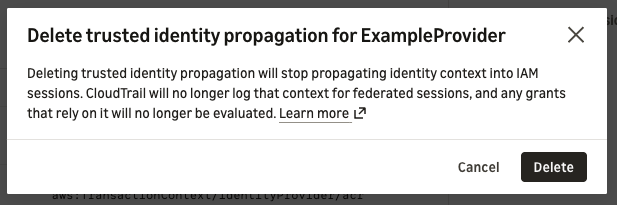
1. Review the effects of deleting TIP, and then choose **Delete**.
1. Return to the **Identity propagation** tab. The expected **Propagation status** is **Not configured**. A value of **Configured** means that TIP remains configured.
### Remove using the `UpdateSAMLProvider` API
To remove TIP programmatically, call the public [`UpdateSAMLProvider`](https://docs.amazonaws.cn/IAM/latest/APIReference/API_UpdateSAMLProvider.html) API operation. Every API request must include the required `SAMLProviderArn` request parameter.
If group-based access is configured, first submit an API request with the `RemoveIdentityCenterInstance` Boolean request parameter set to `true`. After that API request succeeds, submit a second API request with the `RemoveContextProvider` Boolean request parameter set to `true`. If group-based access is not configured, submit only the `RemoveContextProvider` API request.
IAM accepts `RemoveIdentityCenterInstance` when no association exists and clears any stored association ARNs. IAM also accepts `RemoveContextProvider` as a no-op when the provider has no saved `ContextProvider`. If an IAM Identity Center association remains, IAM rejects `RemoveContextProvider` with `InvalidInput`: `Remove the Identity Center instance before removing the context provider.`
#### Amazon CLI
Use the [`aws iam update-saml-provider`](https://docs.amazonaws.cn/cli/latest/reference/iam/update-saml-provider.html) Amazon CLI command.
**To remove TIP from a SAML provider (Amazon CLI)**
1. If group-based access is configured, run:
```bash
aws iam update-saml-provider \
--saml-provider-arn "$SAML_PROVIDER_ARN" \
--remove-identity-center-instance
```
1. After the first command succeeds, remove the TIP mappings:
```bash
aws iam update-saml-provider \
--saml-provider-arn "$SAML_PROVIDER_ARN" \
--remove-context-provider
```
#### Amazon SDK for Python (Boto3)
Use the [`update_saml_provider`](https://boto3.amazonaws.com/v1/documentation/api/latest/reference/services/iam/client/update_saml_provider.html) Amazon SDK for Python method:
```python
import boto3
iam = boto3.client("iam")
saml_provider_arn = "arn:aws:iam::123456789012:saml-provider/ExampleProvider"
# Run this API request only when group-based access is configured.
iam.update_saml_provider(
SAMLProviderArn=saml_provider_arn,
RemoveIdentityCenterInstance=True,
)
# Run this API request after the instance-association request succeeds.
iam.update_saml_provider(
SAMLProviderArn=saml_provider_arn,
RemoveContextProvider=True,
)
```
### Verify that TIP was removed
Run the applicable Amazon CLI commands or Amazon SDK for Python methods in [Verify the TIP configuration](#id_roles_providers_tip_federation_configure_saml-verify-the-tip-configuration).
A successful removal has these results:
+ The `ListSAMLProviders` response includes `IsTrustedIdentityPropagationEnabled` with the value `false`.
+ The `GetSAMLProvider` response omits `ContextProvider`. In an Amazon SDK for Python response, `provider.get("ContextProvider")` therefore returns `None`.
A value of `true` for `IsTrustedIdentityPropagationEnabled` or a returned `ContextProvider` means that TIP remains configured.
If you also removed group-based access, follow [Verify the removed association](id_roles_providers_tip_federation_configure_group_access.md#id_roles_providers_tip_federation_configure_group_access-verify-the-removed-association). The `IdentityCenterInstanceArn` and `IdentityStoreArn` response elements must be absent or `null`.
For TIP-specific configuration failures, see [Troubleshoot TIP configuration](id_roles_providers_tip_federation_getting_started.md#id_roles_providers_tip_federation_getting_started-troubleshoot-tip-configuration).