# Getting started with the Espressif ESP32-DevKitC and the ESP-WROVER-KIT
**Important**
This is an archived version of the FreeRTOS User Guide for use with FreeRTOS release 202012.00. For the latest version of this document, see the [FreeRTOS User Guide](../../../latest/userguide/index.html).
Follow this tutorial to get started with the Espressif ESP32-DevKitC equipped with ESP32-WROOM-32, ESP32-SOLO-1, or ESP-WROVER modules and the ESP-WROVER-KIT-VB. To purchase one from our partner on the Amazon Partner Device catalog, use the following links:
+ [ESP32-WROOM-32 DevKitC](https://devices.amazonaws.com/detail/a3G0L00000AANtjUAH/ESP32-DevKitC)
+ [ESP32-SOLO-1](https://devices.amazonaws.com/detail/a3G0h0000076lSMEAY)
+ [ESP32-WROVER-KIT](https://devices.amazonaws.com/detail/a3G0L00000AANtlUAH/ESP-WROVER-KIT)
These versions of development boards are supported on FreeRTOS.
For more information about the latest versions of these boards, see [ ESP32-DevKitC V4](https://docs.espressif.com/projects/esp-idf/en/release-v4.2/esp32/hw-reference/modules-and-boards.html#esp32-devkitc-v4) or [ ESP-WROVER-KIT v4.1](https://docs.espressif.com/projects/esp-idf/en/release-v4.2/esp32/hw-reference/modules-and-boards.html#esp-wrover-kit-v4-1) on the Espressif website.
**Note**
Currently, the FreeRTOS port for ESP32-WROVER-KIT and ESP DevKitC doesn't support the Symmetric multiprocessing (SMP) feature.
## Overview
This tutorial guides you through the following steps:
1. Connecting your board to a host machine
1. Installing software on the host machine for developing and debugging embedded applications for your microcontroller board
1. Cross compiling a FreeRTOS demo application to a binary image
1. Loading the application binary image to your board, and then running the application
1. Interacting with the application running on your board across a serial connection, for monitoring and debugging purposes
## Prerequisites
Before you get started with FreeRTOS on your Espressif board, you must set up your Amazon account and permissions.
### Sign up for an Amazon Web Services account
If you do not have an Amazon Web Services account, use the following procedure to create one.
**To sign up for Amazon Web Services**
1. Open [http://www.amazonaws.cn/](http://www.amazonaws.cn/) and choose **Sign Up**.
1. Follow the on-screen instructions.
Amazon sends you a confirmation email after the sign-up process is complete. At any time, you can view your current account activity and manage your account by going to [http://www.amazonaws.cn/](http://www.amazonaws.cn/) and choosing **My Account**.
### Secure IAM users
After you sign up for an Amazon Web Services account, safeguard your administrative user by turning on multi-factor authentication (MFA). For instructions, see [Enable a virtual MFA device for an IAM user (console)](https://docs.amazonaws.cn/IAM/latest/UserGuide/id_credentials_mfa_enable_virtual.html#enable-virt-mfa-for-iam-user) in the *IAM User Guide*.
To give other users access to your Amazon Web Services account resources, create IAM users. To secure your IAM users, turn on MFA and only give the IAM users the permissions needed to perform their tasks.
For more information about creating and securing IAM users, see the following topics in the *IAM User Guide*:
+ [Creating an IAM user in your Amazon Web Services account](https://docs.amazonaws.cn//IAM/latest/UserGuide/id_users_create.html)
+ [Access management for Amazon resources](https://docs.amazonaws.cn/IAM/latest/UserGuide/access.html)
+ [Example IAM identity-based policies](https://docs.amazonaws.cn/IAM/latest/UserGuide/access_policies_examples.html)
To provide access, add permissions to your users, groups, or roles:
+ Users managed in IAM through an identity provider:
Create a role for identity federation. Follow the instructions in [Create a role for a third-party identity provider (federation)](https://docs.amazonaws.cn//IAM/latest/UserGuide/id_roles_create_for-idp.html) in the *IAM User Guide*.
+ IAM users:
+ Create a role that your user can assume. Follow the instructions in [Create a role for an IAM user](https://docs.amazonaws.cn//IAM/latest/UserGuide/id_roles_create_for-user.html) in the *IAM User Guide*.
+ (Not recommended) Attach a policy directly to a user or add a user to a user group. Follow the instructions in [Adding permissions to a user (console)](https://docs.amazonaws.cn//IAM/latest/UserGuide/id_users_change-permissions.html#users_change_permissions-add-console) in the *IAM User Guide*.
**Note**
The FreeRTOS 202012.00 release supports ESP-IDF v3.3. If you're using a later version of FreeRTOS, follow the instructions specific to IDFv4.2 at [Get started with the ESP-IDF v4.2](#setup-espressif-idf42).
## Get started with ESP-IDF v3.3
This section shows you how to use ESP-IDF v3.3 on Espressif hardware. To use ESP-IDF v4.2, see [Get started with the ESP-IDF v4.2](#setup-espressif-idf42).
### Set up the Espressif hardware
For more information about setting up the ESP32-DevKitC development board hardware, see the [ESP32-DevKitC V4 Getting Started Guide](https://docs.espressif.com/projects/esp-idf/en/latest/get-started/get-started-devkitc.html).
For information about setting up the ESP-WROVER-KIT development board hardware. see the [ ESP-WROVER-KIT V4.1 Getting Started Guide](https://docs.espressif.com/projects/esp-idf/en/latest/get-started/get-started-wrover-kit.html).
**Important**
When you reach the **Get Started** section of the Espressif guides, stop, and then follow the steps below.
### Set up your development environment
To communicate with your board, you must download and install a toolchain.
#### Setting up the toolchain
**Note**
ESP-IDF v3.3 doesn't support the latest version of the ESP32 compiler. If you have already installed the latest version of the ESP32 compiler, you should uninstall it and use the compatible version of the compiler that is included in the toolchain installation. See the links in this section. To check the version of your compiler, run the following command.
```
xtensa-esp32-elf-gcc --version
```
To set up the toolchain, follow these instructions for your host machine's operating system:
+ [ Standard Setup of Toolchain (ESP-IDF v3.3) for Windows](https://docs.espressif.com/projects/esp-idf/en/v3.3/get-started-cmake/windows-setup.html)
+ [ Standard Setup of Toolchain (ESP-IDF v3.3) for macOS](https://docs.espressif.com/projects/esp-idf/en/v3.3/get-started-cmake/macos-setup.html)
+ [ Standard Setup of Toolchain (ESP-IDF v3.3) for Linux](https://docs.espressif.com/projects/esp-idf/en/v3.3/get-started-cmake/linux-setup.html)
**Important**
When you reach the "Get ESP-IDF" instructions under **Next Steps**, stop, and then return to the instructions on this page.
If you followed the "Get ESP-IDF" instructions under **Next Steps**, just now or on a previous occasion, you should clear the `IDF_PATH` environment variable from your system before you continue. This environment variable was automatically set if you followed the "Get ESP-IDF" instructions.
#### Install CMake
The CMake build system is required to build the FreeRTOS demo and test applications for this device. FreeRTOS supports versions 3.13 and later.
You can download the latest version of CMake from [CMake.org](https://cmake.org/download/). Both source and binary distributions are available.
For more details about using CMake with FreeRTOS, see [Using CMake with FreeRTOS](getting-started-cmake.md).
### Establish a serial connection
To establish a serial connection between your host machine and the ESP32-DevKitC, you must install CP210x USB to UART Bridge VCP drivers. You can download these drivers from [ Silicon Labs](https://www.silabs.com/products/development-tools/software/usb-to-uart-bridge-vcp-drivers).
To establish a serial connection between your host machine and the ESP32-WROVER-KIT, you must install some FTDI virtual COM port drivers. You can download these drivers from [FTDI](https://www.ftdichip.com/Drivers/VCP.htm).
For more information, see [ Establish Serial Connection with ESP32](https://docs.espressif.com/projects/esp-idf/en/latest/get-started/establish-serial-connection.html). After you establish a serial connection, make a note of the serial port for your board's connection. You need it when you build the demo.
### Download and configure FreeRTOS
After you set up your environment, you can download FreeRTOS from [GitHub](https://github.com/aws/amazon-freertos).For instructions, see the [README.md](https://github.com/aws/amazon-freertos/blob/master/README.md) file on the GitHub website.
#### Configure the FreeRTOS demo applications
1. If you're running macOS or Linux, open a terminal prompt. If you're running Windows, open the `mingw32.exe`. [MinGW](https://sourceforge.net/projects/mingw-w64/files/) is a minimalist development environment for native Microsoft Windows applications.
1. To verify that you have Python 2.7.10 or later installed, run
```
python --version
```
The version installed is displayed. If you don't have Python 2.7.10 or later installed, you can install it from the [Python](https://www.python.org/downloads/) website.
1. You need the Amazon Command Line Interface (Amazon CLI) to run Amazon IoT commands. If you're running Windows, use the **easy\_install awscli** to install the Amazon CLI in the mingw32 environment.
If you're running macOS or Linux, see [Installing the Amazon CLI](https://docs.amazonaws.cn/cli/latest/userguide/installing.html).
1. Run **aws configure** and configure the Amazon CLI with your Amazon access key ID, secret access key, and Amazon Region. For more information, see [Configuring the Amazon CLI](https://docs.amazonaws.cn/cli/latest/userguide/cli-chap-getting-started.html).
1. Use the following command to install the Amazon SDK for Python (boto3):
+ On Windows, in the mingw32 environment, run
```
easy_install boto3
```
+ On macOS or Linux, run
```
pip install tornado nose --user
```
and then run
```
pip install boto3 --user
```
FreeRTOS includes the `SetupAWS.py` script to make it easier to set up your Espressif board to connect to Amazon IoT. To configure the script, open `{{freertos}}/tools/aws_config_quick_start/configure.json` and set the following attributes:
`afr_source_dir`
The complete path to the {{freertos}} directory on your computer. Make sure that you use forward slashes to specify this path.
`thing_name`
The name that you want to assign to the Amazon IoT thing that represents your board.
`wifi_ssid`
The SSID of your Wi-Fi network.
`wifi_password`
The password for your Wi-Fi network.
`wifi_security`
The security type for your Wi-Fi network.
The following are valid security types:
+ `eWiFiSecurityOpen` (Open, no security)
+ `eWiFiSecurityWEP` (WEP security)
+ `eWiFiSecurityWPA` (WPA security)
+ `eWiFiSecurityWPA2` (WPA2 security)
**To run the configuration script**
1. If you're running macOS or Linux, open a terminal prompt. If you're running Windows, open `mingw32.exe`.
1. Navigate to the `{{freertos}}/tools/aws_config_quick_start` directory and run
```
python SetupAWS.py setup
```
The script does the following:
+ Creates an IoT thing, certificate, and policy
+ Attaches the IoT policy to the certificate and the certificate to the Amazon IoT thing
+ Populates the `aws_clientcredential.h` file with your Amazon IoT endpoint, Wi-Fi SSID, and credentials
+ Formats your certificate and private key and writes them to the `aws_clientcredential_keys.h` header file
**Note**
The certificate is hardcoded for demonstration purposes only. Production-level applications should store these files in a secure location.
For more information about `SetupAWS.py`, see the `README.md` in the `{{freertos}}/tools/aws_config_quick_start` directory.
### Build, flash, and run the FreeRTOS demo project
You can use CMake to generate the build files, Make to build the application binary, and Espressif's IDF utility to flash your board.
#### Build FreeRTOS on Linux and MacOS (ESP-IDF v3.3)
If you're using Windows, see [Build FreeRTOS on Windows (ESP-IDF v3.3)](#build-espressif-windows-idf33).
Use CMake to generate the build files, and then use Make to build the application.
**To generate the demo application's build files with CMake**
1. Change directories to the root of your FreeRTOS download directory.
1. Use the following command to generate the build files.
```
cmake -DVENDOR=espressif -DBOARD=esp32_wrover_kit -DCOMPILER=xtensa-esp32 -S . -B {{your-build-directory}}
```
**Note**
If you want to build the application for debugging, add the `-DCMAKE_BUILD_TYPE=Debug` flag to this command.
If you want to generate the test application build files, add the `-DAFR_ENABLE_TESTS=1` flag.
The code provided by Espressif uses the lightweight IP (lwIP) stack as the default networking stack. To use the FreeRTOS\+TCP networking stack instead, add the `–DAFR_ESP_FREERTOS_TCP` flag to the CMake command.
To add the lwIP dependency for non-vendor provided code, add the following lines to the CMake dependency file, `CMakeLists.txt`, for your custom Wi-Fi component.
```
# Add a dependency on the bluetooth espressif component to the common component
set(COMPONENT_REQUIRES lwip)
```
**To build the application with make**
1. Change directories to the `build` directory.
1. Use the following command to build the application with Make.
```
make all -j4
```
**Note**
You must generate the build files with the **cmake** command every time you switch between the `aws_demos` project and the `aws_tests` project.
#### Build FreeRTOS on Windows (ESP-IDF v3.3)
On Windows, you must specify a build generator for CMake. Otherwise, CMake defaults to Visual Studio. Espressif officially recommends the Ninja build system because it works on Windows, Linux and MacOS. You must run CMake commands in a native Windows environment like cmd or PowerShell. Running CMake commands in a virtual Linux environment, like MSYS2 or WSL, is not supported.
Use CMake to generate the build files, and then use Make to build the application.
**To generate the demo application's build files with CMake**
1. Change directories to the root of your FreeRTOS download directory.
1. Use the following command to generate the build files.
```
cmake -DVENDOR=espressif -DBOARD=esp32_wrover_kit -DCOMPILER=xtensa-esp32 -GNinja -S . -B {{build-directory}}
```
**Note**
If you want to build the application for debugging, add the `-DCMAKE_BUILD_TYPE=Debug` flag to this command.
If you want to generate the test application build files, add the `-DAFR_ENABLE_TESTS=1` flag.
The code provided by Espressif uses the lightweight IP (lwIP) stack as the default networking stack. To use the FreeRTOS\+TCP networking stack instead, add the `–DAFR_ESP_FREERTOS_TCP` flag to the CMake command.
To add the lwIP dependency for non-vendor provided code, add the following lines to the CMake dependency file, `CMakeLists.txt`, for your custom Wi-Fi component.
```
# Add a dependency on the bluetooth espressif component to the common component
set(COMPONENT_REQUIRES lwip)
```
**To build the application**
1. Change directories to the `build` directory.
1. Invoke Ninja to build the application.
```
ninja
```
Or, use the generic CMake interface to build the application.
```
cmake --build {{build-directory}}
```
**Note**
You must generate the build files with the **cmake** command every time you switch between the `aws_demos` project and the `aws_tests` project.
#### Flash and run FreeRTOS (ESP-IDF v3.3)
This section shows you how to use ESP-IDF v3.3 on Espressif hardware. To use ESP-IDF v4.2, see [Get started with the ESP-IDF v4.2](#setup-espressif-idf42).
Use Espressif's IDF utility (`{{freertos}}/vendors/espressif/esp-idf/tools/idf.py`) to flash your board, run the application, and see logs.
To erase the board's flash, go to the `{{freertos}}` directory and use the following command.
```
./vendors/espressif/esp-idf/tools/idf.py erase_flash -B {{build-directory}}
```
To flash the application binary to your board, use `make`
```
make flash
```
You can also use the IDF script to flash your board:
```
./vendors/espressif/esp-idf/tools/idf.py flash -B {{build-directory}}
```
To monitor:
```
./vendors/espressif/esp-idf/tools/idf.py monitor -p /dev/ttyUSB1 -B {{build-directory}}
```
**Note**
You can combine these commands. For example:
```
./vendors/espressif/esp-idf/tools/idf.py erase_flash flash monitor -p /dev/ttyUSB1 -B {{build-directory}}
```
## Get started with the ESP-IDF v4.2
This section shows you how to use ESP-IDF v4.2 on Espressif hardware. To use ESP-IDF v3.3, see [Get started with ESP-IDF v3.3](#setup-espressif-idf33).
**Note**
The Linux commands in this tutorial require that you use the Bash shell.
### Set up the Espressif hardware
For information about setting up the ESP32-DevKitC development board hardware, see the [ ESP32-DevKitC V4 Getting Started Guide](https://docs.espressif.com/projects/esp-idf/en/release-v4.2/esp32/hw-reference/esp32/get-started-devkitc.html).
For information about setting up the ESP-WROVER-KIT development board hardware, see the [ ESP-WROVER-KIT V4.1 Getting Started Guide](https://docs.espressif.com/projects/esp-idf/en/release-v4.2/esp32/hw-reference/esp32/get-started-wrover-kit.html).
**Important**
When you reach the **Get Started** section of the Espressif guides, stop, and then return to the instructions on this page.
### Set up your development environment
To communicate with your board, you must download and install a toolchain.
#### Setting up the toolchain
To set up the toolchain, follow these instructions for your host machine's operating system:
+ [ Standard Setup of Toolchain and prerequisites (ESP-IDF v4.2) for Windows](https://docs.espressif.com/projects/esp-idf/en/release-v4.2/esp32/get-started/windows-setup.html)
+ [ Standard Setup of Toolchain prerequisites (ESP-IDF v4.2) for macOS](https://docs.espressif.com/projects/esp-idf/en/release-v4.2/esp32/get-started/macos-setup.html)
+ [ Standard Setup of Toolchain prerequisites (ESP-IDF v4.2) for Linux](https://docs.espressif.com/projects/esp-idf/en/release-v4.2/esp32/get-started/linux-setup.html)
**Important**
When you reach the "Get ESP-IDF" instructions under **Next Steps**, stop, and then return to the instructions on this page.
##### Complete the installation (Linux / MacOS)
The ESP-IDF Windows installer installs all of the neceesary tools. The Linux and MacOS platforms require an additional step to complete the installation.
1. Open a command line window
1. Navigate to the FreeRTOS download directory, and then run the following script to download and install the espressif toolchain for your platform.
```
vendors/espressif/esp-idf/install.sh
```
1. Add the ESP-IDF toolchain tools to your terminal's path with the following command.
```
source vendors/espressif/esp-idf/export.sh
```
### Establish a serial connection
To establish a serial connection between your host machine and the ESP32-DevKitC, you must install the CP210x USB to UART Bridge VCP drivers. You can download these drivers from [ Silicon Labs](https://www.silabs.com/products/development-tools/software/usb-to-uart-bridge-vcp-drivers).
To establish a serial connection between your host machine and the ESP32-WROVER-KIT, you must install the FTDI virtual COM port driver. You can download this driver from [FTDI](https://www.ftdichip.com/Drivers/VCP.htm).
For more information, see [ Establish Serial Connection with ESP32](https://docs.espressif.com/projects/esp-idf/en/release-v4.2/esp32/get-started/establish-serial-connection.html). After you establish a serial connection, make a note of the serial port for your board's connection. You need it when you build the demo.
### Download and configure FreeRTOS
After you set up your environment, you can download FreeRTOS from [GitHub](https://github.com/aws/amazon-freertos). For instructions, see the [README.md](https://github.com/aws/amazon-freertos/blob/master/README.md) file on the GitHub website.
#### Configure the FreeRTOS demo applications
1. If you're running macOS or Linux, open a terminal prompt. If you're running Windows, open **mingw32.exe**. ([ MinGW](https://sourceforge.net/projects/mingw-w64/files/) is a minimalist development environment for native Microsoft Windows applications.)
1. To verify that you have Python3 installed, run
```
python --version
```
The version installed is displayed. If you don't have Python 3.0.1 or later installed, you can install it from the [Python](https://www.python.org/downloads/) website.
1. You need the Amazon Command Line Interface (Amazon CLI) to run Amazon IoT commands. If you're running Windows, use the **easy\_install awscli** to install the Amazon CLI in the mingw32 environment.
If you're running macOS or Linux, see [Installing the Amazon CLI](https://docs.amazonaws.cn/cli/latest/userguide/installing.html).
1. Run
```
aws configure
```
and configure the Amazon CLI with your Amazon access key ID, secret access key, and default Amazon Region. For more information, see [Configuring the Amazon CLI](https://docs.amazonaws.cn/cli/latest/userguide/cli-chap-getting-started.html).
1. Use the following command to install the Amazon SDK for Python (boto3):
+ On Windows, in the mingw32 environment, run
```
easy_install boto3
```
+ On macOS or Linux, run
```
pip install tornado nose --user
```
and then run
```
pip install boto3 --user
```
FreeRTOS includes the `SetupAWS.py` script to make it easier to set up your Espressif board to connect to Amazon IoT. To configure the script, open `{{freertos}}/tools/aws_config_quick_start/configure.json` and set the following attributes:
`afr_source_dir`
The complete path to the {{freertos}} directory on your computer. Make sure that you use forward slashes to specify this path.
`thing_name`
The name that you want to assign to the Amazon IoT thing that represents your board.
`wifi_ssid`
The SSID of your Wi-Fi network.
`wifi_password`
The password for your Wi-Fi network.
`wifi_security`
The security type for your Wi-Fi network.
The following are valid security types:
+ `eWiFiSecurityOpen` (Open, no security)
+ `eWiFiSecurityWEP` (WEP security)
+ `eWiFiSecurityWPA` (WPA security)
+ `eWiFiSecurityWPA2` (WPA2 security)
**To run the configuration script**
1. If you're running macOS or Linux, open a terminal prompt. If you're running Windows, open the `mingw32.exe` file.
1. Navigate to the `{{freertos}}/tools/aws_config_quick_start` directory and run
```
python SetupAWS.py setup
```
The script does the following:
+ Creates an IoT thing, certificate, and policy
+ Attaches the IoT policy to the certificate and the certificate to the Amazon IoT thing
+ Populates the `aws_clientcredential.h` file with your Amazon IoT endpoint, Wi-Fi SSID, and credentials
+ Formats your certificate and private key and writes them to the `aws_clientcredential_keys.h` header file
**Note**
The certificate is hardcoded for demonstration purposes only. Production-level applications should store these files in a secure location.
For more information about `SetupAWS.py`, see the `README.md` in the `{{freertos}}/tools/aws_config_quick_start` directory.
### Build, flash, and run the FreeRTOS demo project using the idf.py script
You can use Espressif's IDF utility to generate the build files, build the application binary, and flash your board.
#### Build and flash FreeRTOS on Windows, Linux, and MacOS (ESP-IDF v4.2)
Use the `idf.py` script to build the project and flash the binaries onto your device.
**Note**
Some setups might require that you use the port option `"-p {{port-name}}"` with `idf.py` to specify the correct port, as in the following example.
```
idf.py -p /dev/cu.usbserial-00101301B flash
```
**To build and flash the project**
1. Navigate to the root of your FreeRTOS download directory.
1. In a command line window, enter the following command to add the ESP-IDF tools to your terminal's PATH.
Windows
```
vendors\espressif\esp-idf\export.bat
```
Linux / MacOS
```
source vendors/espressif/esp-idf/export.sh
```
1. Configure cmake in the `build` directory and build the firmware image with the following command.
```
idf.py -DVENDOR=espressif -DBOARD=esp32_wrover_kit -DCOMPILER=xtensa-esp32 build
```
You should see output like the following.
```
Running cmake in directory /path/to/hello_world/build
Executing "cmake -G Ninja --warn-uninitialized /path/to/hello_world"...
Warn about uninitialized values.
-- Found Git: /usr/bin/git (found version "2.17.0")
-- Building empty aws_iot component due to configuration
-- Component names: ...
-- Component paths: ...
... (more lines of build system output)
[527/527] Generating hello-world.bin
esptool.py v2.3.1
Project build complete. To flash, run this command:
../../../components/esptool_py/esptool/esptool.py -p (PORT) -b 921600 write_flash --flash_mode dio --flash_size detect --flash_freq 40m 0x10000 build/hello-world.bin build 0x1000 build/bootloader/bootloader.bin 0x8000 build/partition_table/partition-table.bin
or run 'idf.py -p PORT flash'
```
If there are no errors, the build will generate the firmware binary .bin files.
1. Erase your development board's flash memory with the following command.
```
idf.py erase_flash
```
1. Use the `idf.py` script to flash the application binary to your board.
```
idf.py flash
```
1. Monitor the output from your board's serial port with the following command.
```
idf.py monitor
```
**Note**
You can combine these commands such as in the following example.
```
idf.py erase_flash flash monitor
```
**Note**
For certain host machine setups, you must specify the port when you flash the board such as in the following example.
```
idf.py erase_flash flash monitor -p {{/dev/ttyUSB1}}
```
#### Build and Flash FreeRTOS with CMake
In addition to the `idf.py` script provided by the IDF SDK to build and run your code, you can also build the project with CMake. Currently, it supports either Unix Makefiles or the Ninja build system.
**To build and flash the project**
1. In a command line window, navigate to the root of your FreeRTOS download directory.
1. Run the following script to add the ESP-IDF tools to your shell's PATH.
Windows
```
vendors\espressif\esp-idf\export.bat
```
Linux / MacOS
```
source vendors/espressif/esp-idf/export.sh
```
1. Enter the following command to generate the build files.
With Unix Makefiles
```
cmake -DVENDOR=espressif -DBOARD=esp32_wrover_kit -DCOMPILER=xtensa-esp32 -S . -B {{./YOUR_BUILD_DIRECTORY}} -DAFR_ENABLE_ALL_MODULES=1 -DAFR_ENABLE_TESTS=0
```
With Ninja
```
cmake -DVENDOR=espressif -DBOARD=esp32_wrover_kit -DCOMPILER=xtensa-esp32 -S . -B {{./YOUR_BUILD_DIRECTORY}} -DAFR_ENABLE_ALL_MODULES=1 -DAFR_ENABLE_TESTS=0 -GNinja
```
1. Erase the flash and then flash the board.
With Unix Makefiles
```
make -C {{./YOUR_BUILD_DIRECTORY}} erase_flash
```
```
make -C {{./YOUR_BUILD_DIRECTORY}} flash
```
With Ninja
```
ninja -C {{./YOUR_BUILD_DIRECTORY}} erase_flash
```
```
ninja -C {{./YOUR_BUILD_DIRECTORY}} flash
```
## Monitoring MQTT messages on the cloud
You can use the MQTT client in the Amazon IoT console to monitor the messages that your device sends to the Amazon Cloud.
**To subscribe to the MQTT topic with the Amazon IoT MQTT client**
1. Navigate to the [Amazon IoT console](https://console.amazonaws.cn/iotv2/).
1. In the navigation pane, choose **Test** to open the MQTT client.
1. In **Subscription topic**, enter **{{your-thing-name}}/example/topic**, and then choose **Subscribe to topic**.
## Run the Bluetooth Low Energy demos
FreeRTOS supports [Bluetooth Low Energy](https://docs.amazonaws.cn/freertos/latest/userguide/freertos-ble-library.html) connectivity.
To run the FreeRTOS demo project across Bluetooth Low Energy, you must run the FreeRTOS Bluetooth Low Energy Mobile SDK Demo Application on an iOS or Android mobile device.
**To set up the FreeRTOS Bluetooth Low Energy mobile SDK demo application**
1. Follow the instructions in [Mobile SDKs for FreeRTOS Bluetooth Devices](https://docs.amazonaws.cn/freertos/latest/userguide/freertos-ble-mobile.html) to download and install the SDK for your mobile platform on your host computer.
1. Follow the instructions in [FreeRTOS Bluetooth Low Energy Mobile SDK Demo Application](https://docs.amazonaws.cn/freertos/latest/userguide/ble-demo.html#ble-sdk-app) to set up the demo mobile application on your mobile device.
For instructions about how to run the MQTT over Bluetooth Low Energy demo on your board, see the [MQTT over Bluetooth Low Energy Demo Application](https://docs.amazonaws.cn/freertos/latest/userguide/ble-demo.html#ble-demo-mqtt).
For instructions about how to run the Wi-Fi provisioning demo on your board, see the [Wi-Fi Provisioning Demo Application](https://docs.amazonaws.cn/freertos/latest/userguide/ble-demo.html#ble-demo-wifi).
## Using FreeRTOS in your own CMake project for ESP32
If you want to consume FreeRTOS in your own CMake project, you can set it up as a subdirectory and build it together with your application. First, get a copy of FreeRTOS from [GitHub](https://github.com/aws/amazon-freertos). You can also set it up as a Git submodule with the following command so it's easier to update in the future.
```
git submodule add -b release https://github.com/aws/amazon-freertos.git {{freertos}}
```
If a later version is released, you can update your local copy with these commands.
```
# Pull the latest changes from the remote tracking branch.
git submodule update --remote -- {{freertos}}
```
```
# Commit the submodule change because it is pointing to a different revision now.
git add {{freertos}}
```
```
git commit -m "Update FreeRTOS to a new release"
```
If your project has the following directory structure:
```
- freertos (the copy that you obtained from GitHub or the Amazon IoT console)
- src
- main.c (your application code)
- CMakeLists.txt
```
Then the following is an example of the top-level `CMakeLists.txt` file that can be used to build your application together with FreeRTOS.
------
#### [ ESP-IDF v3.3 ]
```
cmake_minimum_required(VERSION 3.13)
project(freertos_examples)
add_executable(my_app src/main.c)
# Tell IDF build to link against this target.
set(IDF_PROJECT_EXECUTABLE my_app)
# Add FreeRTOS as a subdirectory. AFR_BOARD tells which board to target.
set(AFR_BOARD espressif.esp32_devkitc CACHE INTERNAL "")
add_subdirectory(freertos)
# Link against the mqtt library so that we can use it. Dependencies are transitively
# linked.
target_link_libraries(my_app PRIVATE AFR::mqtt)
```
------
#### [ ESP-IDF v4.2 ]
```
cmake_minimum_required(VERSION 3.13)
project(freertos_examples)
# Pull in ESP-IDF defined CMake build infrastructure logic to configure the project, discover all the components, etc
set(esp_idf_dir "${CMAKE_CURRENT_LIST_DIR}/freertos/vendors/espressif/esp-idf")
include(${esp_idf_dir}/tools/cmake/idf.cmake)
# Tell IDF build to link against this target.
set(IDF_PROJECT_EXECUTABLE my_app)
get_filename_component(
IDF_EXECUTABLE_SRCS
"src/main.c" ABSOLUTE
)
```
------
To build the project, run the following CMake commands. Make sure the ESP32 compiler is in the PATH environment variable.
```
cmake -S . -B {{build-directory}} -DCMAKE_TOOLCHAIN_FILE=freertos/tools/cmake/toolchains/xtensa-esp32.cmake -GNinja
```
```
cmake --build build
```
To flash the application to your board, run the following command.
```
cmake --build {{build-directory}} --target flash
```
### Using components from FreeRTOS
After running CMake, you can find all available components in the summary output. It should look something like the following example.
```
====================Configuration for FreeRTOS====================
Version: 201910.00
Git version: 201910.00-388-gcb3612cb7
Target microcontroller:
vendor: Espressif
board: ESP32-DevKitC
description: Development board produced by Espressif that comes in two
variants either with ESP-WROOM-32 or ESP32-WROVER module
family: ESP32
data ram size: 520KB
program memory size: 4MB
Host platform:
OS: Linux-4.15.0-66-generic
Toolchain: xtensa-esp32
Toolchain path: /opt/xtensa-esp32-elf
CMake generator: Ninja
FreeRTOS modules:
Modules to build: ble, ble_hal, ble_wifi_provisioning, common, crypto, defender,
dev_mode_key_provisioning, freertos_plus_tcp, greengrass,
https, kernel, mqtt, ota, pkcs11, pkcs11_implementation,
platform, secure_sockets, serializer, shadow, tls, wifi
Enabled by user: ble, ble_hal, ble_wifi_provisioning, defender, greengrass,
https, mqtt, ota, pkcs11, pkcs11_implementation, platform,
secure_sockets, shadow, wifi
Enabled by dependency: common, crypto, demo_base, dev_mode_key_provisioning,
freertos, freertos_plus_tcp, kernel, pkcs11_mbedtls,
secure_sockets_freertos_plus_tcp, serializer, tls, utils
3rdparty dependencies: http_parser, jsmn, mbedtls, pkcs11, tinycbor
Available demos: demo_ble, demo_ble_numeric_comparison, demo_defender,
demo_greengrass_connectivity, demo_https, demo_mqtt, demo_ota,
demo_shadow, demo_tcp, demo_wifi_provisioning
Available tests:
=========================================================================
```
You can reference any components from the `Modules to build` list. To link them into your application, put the `AFR::` namespace in front of the name, for example, `AFR::mqtt`, `AFR::ota`, and so on.
### Add custom components to ESP-IDF
You can add more components to the ESP-IDF build environment. For example, assuming you want to add a component called `example_component`, and your project looks like this
```
- freertos
- components
- example_component
- include
- example_component.h
- src
- example_component.c
- CMakeLists.txt
- src
- main.c
- CMakeLists.txt
```
then the following is an example of the `CMakeLists.txt` file for your component.
------
#### [ ESP-IDF v3.3 ]
```
# include paths of this components.
set(COMPONENT_ADD_INCLUDEDIRS include)
# source files of this components.
set(COMPONENT_SRCDIRS src)
# Alternatively, use COMPONENT_SRCS to specify source files explicitly
# set(COMPONENT_SRCS src/{{example_component.c}})
# add this components, this will define a CMake library target.
register_component()
```
------
#### [ ESP-IDF v4.2 ]
```
# Use idf_component_register to add this component, this will define a CMake library target.
# Specify component sources in SRCS.
# Specify component include directories in INCLUDE_DIRS.
idf_component_register(SRCS "src/foo.c"
INCLUDE_DIRS "include")
# Standard CMake function can be used to specify dependencies. ${COMPONENT_TARGET} is defined
# from esp-idf when you call register_component, by default it's idf_component_.
target_link_libraries(${COMPONENT_TARGET} PRIVATE AFR::mqtt)
```
------
You can also specify dependencies using the standard CMake function `target_link_libraries`. Note that the target name for your component is stored in the variable `COMPONENT_TARGET`, defined by the ESP-IDF.
------
#### [ ESP-IDF v3.3 ]
```
# add this component, this will define a CMake library target.
register_component()
# standard CMake function can be used to specify dependencies. ${COMPONENT_TARGET} is defined
# from esp-idf when you call register_component, by default it's idf_component_.
target_link_libraries(${COMPONENT_TARGET} PRIVATE AFR::mqtt)
```
------
#### [ ESP-IDF v4.2 ]
```
# add this component, this will define a CMake library target.
idf_component_register(SRCS "src/foo.c"
INCLUDE_DIRS "include")
# standard CMake function can be used to specify dependencies. ${COMPONENT_TARGET} is defined
# from esp-idf when you call register_component, by default it's idf_component_.
target_link_libraries(${COMPONENT_TARGET} PRIVATE AFR::mqtt)
```
------
For ESP components, this is done by setting two variables `COMPONENT_REQUIRES` and `COMPONENT_PRIV_REQUIRES`. See [ Build System (CMake)](https://docs.espressif.com/projects/esp-idf/en/v3.3/api-guides/build-system-cmake.html) in the *ESP-IDF Programming Guide v4.2*.
------
#### [ ESP-IDF v3.3 ]
```
# If the dependencies are from ESP-IDF, use these 2 variables. Note these need to be
# set before calling register_component().
set(COMPONENT_REQUIRES log)
set(COMPONENT_PRIV_REQUIRES lwip)
```
------
#### [ ESP-IDF v4.2 ]
```
# If the dependencies are from ESP-IDF, use these 2 variables (REQUIRES, PRIV_REQUIRES)
# in the idf_component_register call: (Refer here for information on the
# idf_component_register function: https://docs.espressif.com/projects/esp-idf/en/v4.2/esp32/api-guides/build-system.html#cmake-component-register)
idf_component_register(SRCS "src/foo.c"
INCLUDE_DIRS "include"
REQUIRES log
PRIV_REQUIRES lwip)
```
------
Then, in the top level `CMakeLists.txt` file, you tell ESP-IDF where to find these components. Add the following lines anywhere before `add_subdirectory(freertos)`.
------
#### [ ESP-IDF v3.3 ]
```
# Add some extra components. IDF_EXTRA_COMPONENT_DIRS is a variable used by ESP-IDF
# to collect extra components.
get_filename_component(
EXTRA_COMPONENT_DIRS
"components/{{example_component}}" ABSOLUTE
)
list(APPEND IDF_EXTRA_COMPONENT_DIRS ${EXTRA_COMPONENT_DIRS})
```
------
#### [ ESP-IDF v4.2 ]
```
# Add some extra components. IDF_EXTRA_COMPONENT_DIRS is a variable used by ESP-IDF
# to collect extra components.
get_filename_component(
EXTRA_COMPONENT_DIRS
"components/{{example_component}}" ABSOLUTE
)
idf_build_component(${EXTRA_COMPONENT_DIRS})
```
------
This component is now automatically linked to your application code by default. You should be able to include its header files and call the functions it defines.
### Override the configurations for FreeRTOS
There's currently no well-defined approach to redefining the configs outside of the FreeRTOS source tree. By default, CMake will look for the `{{freertos}}/vendors/espressif/boards/esp32/aws_demos/config_files/` and `{{freertos}}/demos/include/` directories. However, you can use a workaround to tell the compiler to search other directories first. For example, you can add another folder for FreeRTOS configurations.
```
- freertos
- freertos-configs
- aws_clientcredential.h
- aws_clientcredential_keys.h
- iot_mqtt_agent_config.h
- iot_config.h
- components
- src
- CMakeLists.txt
```
The files under `freertos-configs` are copied from the `{{freertos}}/vendors/espressif/boards/esp32/aws_demos/config_files/` and `{{freertos}}/demos/include/` directories. Then, in your top level `CMakeLists.txt` file, add this line before `add_subdirectory(freertos)` so that the compiler will search this directory first.
```
include_directories(BEFORE freertos-configs)
```
### Providing your own sdkconfig for ESP-IDF
In case you want to provide your own `sdkconfig.default`, you can set the CMake variable `IDF_SDKCONFIG_DEFAULTS`, from the command line:
```
cmake -S . -B {{build-directory}} -DIDF_SDKCONFIG_DEFAULTS={{path_to_your_sdkconfig_defaults}} -DCMAKE_TOOLCHAIN_FILE=freertos/tools/cmake/toolchains/xtensa-esp32.cmake -GNinja
```
If you don’t specify a location for your own `sdkconfig.default` file, FreeRTOS will use the default file located at `{{freertos}}/vendors/espressif/boards/esp32/aws_demos/sdkconfig.defaults`.
### Summary
If you have a project with a component called `example_component`, and you want to override some configurations, here's a complete example of the top level `CMakeLists.txt` file.
------
#### [ ESP-IDF v3.3 ]
```
cmake_minimum_required(VERSION 3.13)
project(freertos_examples)
add_executable(my_app src/main.c)
# Tell IDF build to link against this target.
set(IDF_PROJECT_EXECUTABLE my_app)
# Add some extra components. IDF_EXTRA_COMPONENT_DIRS is a variable used by ESP-IDF
# to collect extra components.
get_filename_component(
EXTRA_COMPONENT_DIRS
"components/{{example_component}}" ABSOLUTE
)
list(APPEND IDF_EXTRA_COMPONENT_DIRS ${EXTRA_COMPONENT_DIRS})
# Override the configurations for FreeRTOS.
include_directories(BEFORE {{freertos}}-configs)
# Add FreeRTOS as a subdirectory. AFR_BOARD tells which board to target.
set(AFR_BOARD espressif.esp32_devkitc CACHE INTERNAL "")
add_subdirectory({{freertos}})
# Link against the mqtt library so that we can use it. Dependencies are transitively
# linked.
target_link_libraries(my_app PRIVATE AFR::mqtt)
```
------
#### [ ESP-IDF v4.2 ]
```
cmake_minimum_required(VERSION 3.13)
project(freertos_examples)
# Pull in ESP-IDF defined CMake build infrastructure logic to configure the project, discover all the components, etc
set(esp_idf_dir "${CMAKE_CURRENT_LIST_DIR}/freertos/vendors/espressif/esp-idf")
include(${esp_idf_dir}/tools/cmake/idf.cmake)
# Tell IDF build to link against this target.
set(IDF_PROJECT_EXECUTABLE my_app)
get_filename_component(
IDF_EXECUTABLE_SRCS
"src/main.c" ABSOLUTE
)
# Add some extra components. IDF_EXTRA_COMPONENT_DIRS is an variable used by ESP-IDF
# to collect extra components.
get_filename_component(
EXTRA_COMPONENT_DIRS
"components/foo" ABSOLUTE
)
idf_build_component(${EXTRA_COMPONENT_DIRS})
# Override the configurations for FreeRTOS.
include_directories(BEFORE {{freertos}}-configs)
# Add FreeRTOS as a subdirectory. AFR_BOARD tells which board to target.
set(AFR_BOARD espressif.esp32_devkitc CACHE INTERNAL "")
add_subdirectory({{freertos}})
# Link against the mqtt library so that we can use it. Dependencies are transitively
# linked.
target_link_libraries(my_app PRIVATE AFR::mqtt)
```
For more information about the Espressif build system with CMake, see [ Build System](https://docs.espressif.com/projects/esp-idf/en/v4.2/esp32/api-guides/build-system.html#) in the Espressif API Guides
------
## Troubleshooting
+ If you're running macOS and the operating system doesn't recognize your ESP-WROVER-KIT, make sure you don't have the D2XX drivers installed. To uninstall them, follow the instructions in the [ FTDI Drivers Installation Guide for macOS X](http://www.ftdichip.com/Support/Documents/AppNotes/AN_134_FTDI_Drivers_Installation_Guide_for_MAC_OSX.pdf).
+ The monitor utility provided by ESP-IDF (and invoked using **make monitor**) helps you decode addresses. For this reason, it can help you get some meaningful backtraces in the event the application stops working. For more information, see [ Automatic Address Decoding](https://docs.espressif.com/projects/esp-idf/en/release-v4.2/esp32/api-guides/tools/idf-monitor.html#automatic-address-decoding) on the Espressif website.
+ It's also possible to enable GDBstub for communication with gdb without requiring any special JTAG hardware. For more information, see [ Launching GDB with GDBStub](https://docs.espressif.com/projects/esp-idf/en/release-v4.2/esp32/api-guides/tools/idf-monitor.html#launching-gdb-with-gdbstub) on the Espressif website.
+ For information about setting up an OpenOCD-based environment if JTAG hardware-based debugging is required, see [ JTAG Debugging](https://docs.espressif.com/projects/esp-idf/en/latest/esp32/api-guides/jtag-debugging/index.html) on the Espressif website.
+ If `pyserial` can't be installed using `pip` on macOS, download it from the [pyserial website](https://pypi.org/simple/pyserial).
+ If the board resets continuously, try erasing the flash by entering the following command on the terminal.
```
make erase_flash
```
+ If you see errors when you run `idf_monitor.py`, use Python 2.7.
+ Required libraries from ESP-IDF are included in FreeRTOS, so there is no need to download them externally. If the `IDF_PATH` environment variable is set, we recommend that you clear it before you build FreeRTOS.
+ On Windows, it can take 3-4 minutes for the project to build. You can use the `-j4` switch on the **make** command to reduce the build time:
```
make flash monitor -j4
```
+ If your device has trouble connecting to Amazon IoT, open the `aws_clientcredential.h` file, and verify that the configuration variables are properly defined in the file. `clientcredentialMQTT_BROKER_ENDPOINT[]` should look like `{{1234567890123}}-ats.iot.{{us-east-1}}.amazonaws.com`.
+ If you're following the steps in [Using FreeRTOS in your own CMake project for ESP32](#getting_started_espressif_cmake_project) and you see undefined reference errors from the linker, it's usually because of missing dependent libraries or demos. To add them, update the `CMakeLists.txt` file (under the root directory) using the standard CMake function `target_link_libraries`.
+ ESP-IDF v4.2 supports the use of the *xtensa-esp32-elf-gcc 8.2.0.* toolchain. If you're using an earlier version of the Xtensa toolchain, download the required version.
+ If you see an error log like the following about python dependencies that are not being met for ESP-IDF v4.2.
```
The following Python requirements are not satisfied:
click>=5.0
pyserial>=3.0
future>=0.15.2
pyparsing>=2.0.3,<2.4.0
pyelftools>=0.22
gdbgui==0.13.2.0
pygdbmi<=0.9.0.2
reedsolo>=1.5.3,<=1.5.4
bitstring>=3.1.6
ecdsa>=0.16.0
Please follow the instructions found in the "Set up the tools" section of ESP-IDF Getting Started Guide
```
Install the python dependencies on your platform using the following Python command:
```
{{root}}/vendors/espressif/esp-idf/requirements.txt
```
For more troubleshooting information, see [Troubleshooting getting started](gsg-troubleshooting.md).
## Debugging
### Debugging code on Espressif ESP32-DevKitC and ESP-WROVER-KIT (ESP-IDF v3.3)
This section shows you how to debug Espressif hardware using ESP-IDF v3.3. To debug using ESP-IDF v4.2, see [Debugging code on Espressif ESP32-DevKitC and ESP-WROVER-KIT (ESP-IDF v4.2)](#debugging-espressif-idf42).
You need a JTAG to USB cable. We use a USB to MPSSE cable (for example, the [FTDI C232HM-DDHSL-0](http://www.ftdichip.com/Products/Cables/USBMPSSE.htm)).
#### ESP-DevKitC JTAG setup
For the FTDI C232HM-DDHSL-0 cable, these are the connections to the ESP32 DevkitC.
| C232HM-DDHSL-0 Wire Color | ESP32 GPIO Pin | JTAG Signal Name |
| --- | --- | --- |
| Brown (pin 5) | IO14 | TMS |
| Yellow (pin 3) | IO12 | TDI |
| Black (pin 10) | GND | GND |
| Orange (pin 2) | IO13 | TCK |
| Green (pin 4) | IO15 | TDO |
#### ESP-WROVER-KIT JTAG setup
For the FTDI C232HM-DDHSL-0 cable, these are the connections to the ESP32-WROVER-KIT.
| C232HM-DDHSL-0 Wire Color | ESP32 GPIO Pin | JTAG Signal Name |
| --- | --- | --- |
| Brown (pin 5) | IO14 | TMS |
| Yellow (pin 3) | IO12 | TDI |
| Orange (pin 2) | IO13 | TCK |
| Green (pin 4) | IO15 | TDO |
These tables were developed from the [ FTDI C232HM-DDHSL-0 datasheet](https://www.ftdichip.com/Support/Documents/DataSheets/Cables/DS_C232HM_MPSSE_CABLE.pdf). For more information, see the section "C232HM MPSSE Cable Connection and Mechanical Details in the data sheet.
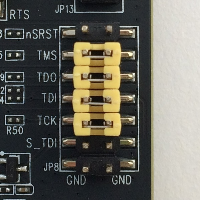
To enable JTAG on the ESP-WROVER-KIT, place jumpers on the TMS, TDO, TDI, TCK, and S\_TDI pins as shown here.
#### Debugging on Windows (ESP-IDF v3.3)
**To set up for debugging on Windows**
1. Connect the USB side of the FTDI C232HM-DDHSL-0 to your computer and the other side as described in [Debugging code on Espressif ESP32-DevKitC and ESP-WROVER-KIT (ESP-IDF v3.3)](#debugging-espressif-idf33). The FTDI C232HM-DDHSL-0 device should appear in **Device Manager** under **Universal Serial Bus Controllers**.
1. Under the list of universal serial bus devices, right-click the **C232HM-DDHSL-0** device, and choose **Properties**.
**Note**
The device might be listed as **USB Serial Port**.
In the properties window, choose the **Details** tab to see the properties of the device. If the device isn't listed, install the [Windows driver for FTDI C232HM-DDHSL-0](http://www.ftdichip.com/Drivers/D2XX.htm).
1. On the **Details** tab, choose **Property**, and then choose **Hardware IDs**. You should see something like this in the **Value** field.
```
FTDIBUS\COMPORT&VID_0403&PID_6014
```
In this example, the vendor ID is 0403 and the product ID is 6014.
Verify these IDs match the IDs in `projects/espressif/esp32/make/aws_demos/esp32_devkitj_v1.cfg`. The IDs are specified in a line that begins with `ftdi_vid_pid` followed by a vendor ID and a product ID.
```
ftdi_vid_pid 0x0403 0x6014
```
1. Download [OpenOCD for Windows](https://github.com/espressif/openocd-esp32/releases).
1. Unzip the file to `C:\` and add `C:\openocd-esp32\bin` to your system path.
1. OpenOCD requires libusb, which is not installed by default on Windows.
**To install libusb**
1. Download [zadig.exe](https://zadig.akeo.ie).
1. Run `zadig.exe`. From the **Options** menu, choose **List All Devices**.
1. From the drop-down menu, choose **C232HM-DDHSL-0**.
1. In the target driver field, to the right of the green arrow, choose **WinUSB**.
1. From the dropdown list under the target driver field, choose the arrow, and then choose **Install Driver**. Choose **Replace Driver**.
1. Open a command prompt, navigate to `projects/espressif/esp32/make/aws_demos` and run the following command.
For ESP32-WROOM-32 and ESP32-WROVER
```
openocd.exe -f esp32_devkitj_v1.cfg -f esp-wroom-32.cfg
```
For ESP32-SOLO-1
```
openocd.exe -f esp32_devkitj_v1.cfg -f esp-solo-1.cfg
```
Leave this command prompt open.
1. Open a new command prompt, navigate to your `msys32` directory, and run `mingw32.exe`.
1. In the mingw32 terminal, navigate to `projects/espressif/esp32/make/aws_demos` and run
```
make flash monitor
```
1. Open another mingw32 terminal, navigate to `projects/espressif/esp32/make/aws_demos` and wait until the demo starts running on your board. When it does, run `xtensa-esp32-elf-gdb -x gdbinit build/aws_demos.elf`. The program should stop in the `main` function.
**Note**
The ESP32 supports a maximum of two break points.
#### Debugging on macOS (ESP-IDF v3.3)
1. Download the [FTDI driver for macOS](http://www.ftdichip.com/Drivers/VCP.htm).
1. Download [OpenOCD](https://github.com/espressif/openocd-esp32/releases).
1. Extract the downloaded .tar file and set the path in `.bash_profile` to `{{OCD_INSTALL_DIR}}/openocd-esp32/bin`.
1. Use the following command to install `libusb` on macOS.
```
brew install libusb
```
1. Use the following command to unload the serial port driver.
```
sudo kextunload -b com.FTDI.driver.FTDIUSBSerialDriver
```
1. If you're running a macOS version later than 10.9, use the following command to unload the Apple FTDI driver.
```
sudo kextunload -b com.apple.driver.AppleUSBFTDI
```
1. Use the following command to get the product ID and vendor ID of the FTDI cable. It lists the attached USB devices.
```
system_profiler SPUSBDataType
```
The output from `system_profiler` should look like the following.
```
{{DEVICE}}:
Product ID: {{product-ID}}
Vendor ID: {{vendor-ID}} (Future Technology Devices International Limited)
```
1. Open the `projects/espressif/esp32/make/aws_demos/esp32_devkitj_v1.cfg` file. The vendor ID and product ID for your device are specified in a line that begins with `ftdi_vid_pid`. Change the IDs to match the IDs from the `system_profiler` output in the previous step.
1. Open a terminal window, navigate to `projects/espressif/esp32/make/aws_demos`, and use the following command to run OpenOCD.
For ESP32-WROOM-32 and ESP32-WROVER:
```
openocd -f esp32_devkitj_v1.cfg -f esp-wroom-32.cfg
```
For ESP32-SOLO-1:
```
openocd -f esp32_devkitj_v1.cfg -f esp-solo-1.cfg
```
1. Open a new terminal, and use the following command to load the FTDI serial port driver.
```
sudo kextload -b com.FTDI.driver.FTDIUSBSerialDriver
```
1. Navigate to `projects/espressif/esp32/make/aws_demos`, and run the following command.
```
make flash monitor
```
1. Open another new terminal, navigate to `projects/espressif/esp32/make/aws_demos`, and run the following command.
```
xtensa-esp32-elf-gdb -x gdbinit build/aws_demos.elf
```
The program should stop at `main()`.
#### Debugging on Linux (ESP-IDF v3.3)
1. Download [OpenOCD](https://github.com/espressif/openocd-esp32/releases). Extract the tarball and follow the installation instructions in the readme file.
1. Use the following command to install libusb on Linux.
```
sudo apt-get install libusb-1.0
```
1. Open a terminal and enter **ls -l /dev/ttyUSB\*** to list all USB devices connected to your computer. This helps you check if the board's USB ports are recognized by the operating system. You should see output like the following.
```
$ls -l /dev/ttyUSB*
crw-rw---- 1 root dialout 188, 0 Jul 10 19:04 /dev/ttyUSB0
crw-rw---- 1 root dialout 188, 1 Jul 10 19:04 /dev/ttyUSB1
```
1. Sign off and then sign in and cycle the power to the board to make the changes take effect. In a terminal prompt, list the USB devices. Make sure the group owner has changed from `dialout` to `plugdev`.
```
$ls -l /dev/ttyUSB*
crw-rw---- 1 root plugdev 188, 0 Jul 10 19:04 /dev/ttyUSB0
crw-rw---- 1 root plugdev 188, 1 Jul 10 19:04 /dev/ttyUSB1
```
The `/dev/ttyUSBn` interface with the lower number is used for JTAG communication. The other interface is routed to the ESP32's serial port (UART) and is used for uploading code to the ESP32’s flash memory.
1. In a terminal window, navigate to `projects/espressif/esp32/make/aws_demos`, and use the following command to run OpenOCD.
For ESP32-WROOM-32 and ESP32-WROVER:
```
openocd -f esp32_devkitj_v1.cfg -f esp-wroom-32.cfg
```
For ESP32-SOLO-1:
```
openocd -f esp32_devkitj_v1.cfg -f esp-solo-1.cfg
```
1. Open another terminal, navigate to `projects/espressif/esp32/make/aws_demos`, and run the following command.
```
make flash monitor
```
1. Open another terminal, navigate to `projects/espressif/esp32/make/aws_demos`, and run the following command:
```
xtensa-esp32-elf-gdb -x gdbinit build/aws_demos.elf
```
The program should stop in `main()`.
### Debugging code on Espressif ESP32-DevKitC and ESP-WROVER-KIT (ESP-IDF v4.2)
This section shows you how to debug Espressif hardware using ESP-IDF v4.2. To debug using ESP-IDF v3.3, see [Debugging code on Espressif ESP32-DevKitC and ESP-WROVER-KIT (ESP-IDF v3.3)](#debugging-espressif-idf33).
You need a JTAG to USB cable. We use a USB to MPSSE cable (for example, the [FTDI C232HM-DDHSL-0](http://www.ftdichip.com/Products/Cables/USBMPSSE.htm)).
#### ESP-DevKitC JTAG setup
For the FTDI C232HM-DDHSL-0 cable, these are the connections to the ESP32 DevkitC.
| C232HM-DDHSL-0 Wire Color | ESP32 GPIO Pin | JTAG Signal Name |
| --- | --- | --- |
| Brown (pin 5) | IO14 | TMS |
| Yellow (pin 3) | IO12 | TDI |
| Black (pin 10) | GND | GND |
| Orange (pin 2) | IO13 | TCK |
| Green (pin 4) | IO15 | TDO |
#### ESP-WROVER-KIT JTAG setup
For the FTDI C232HM-DDHSL-0 cable, these are the connections to the ESP32-WROVER-KIT.
| C232HM-DDHSL-0 Wire Color | ESP32 GPIO Pin | JTAG Signal Name |
| --- | --- | --- |
| Brown (pin 5) | IO14 | TMS |
| Yellow (pin 3) | IO12 | TDI |
| Orange (pin 2) | IO13 | TCK |
| Green (pin 4) | IO15 | TDO |
These tables were developed from the [ FTDI C232HM-DDHSL-0 datasheet](https://www.ftdichip.com/Support/Documents/DataSheets/Cables/DS_C232HM_MPSSE_CABLE.pdf). For more information, see the section "C232HM MPSSE Cable Connection and Mechanical Details in the data sheet.
To enable JTAG on the ESP-WROVER-KIT, place jumpers on the TMS, TDO, TDI, TCK, and S\_TDI pins as shown here.

#### Debugging on Windows (ESP-IDF v4.2)
**To set up for debugging on Windows**
1. Connect the USB side of the FTDI C232HM-DDHSL-0 to your computer and the other side as described in [Debugging code on Espressif ESP32-DevKitC and ESP-WROVER-KIT (ESP-IDF v4.2)](#debugging-espressif-idf42). The FTDI C232HM-DDHSL-0 device should appear in **Device Manager** under **Universal Serial Bus Controllers**.
1. Under the list of universal serial bus devices, right-click the **C232HM-DDHSL-0** device, and choose **Properties**.
**Note**
The device might be listed as **USB Serial Port**.
In the properties window, choose the **Details** tab to see the properties of the device. If the device isn't listed, install the [Windows driver for FTDI C232HM-DDHSL-0](http://www.ftdichip.com/Drivers/D2XX.htm).
1. On the **Details** tab, choose **Property**, and then choose **Hardware IDs**. You should see something like this in the **Value** field.
```
FTDIBUS\COMPORT&VID_0403&PID_6014
```
In this example, the vendor ID is 0403 and the product ID is 6014.
Verify these IDs match the IDs in `projects/espressif/esp32/make/aws_demos/esp32_devkitj_v1.cfg`. The IDs are specified in a line that begins with `ftdi_vid_pid` followed by a vendor ID and a product ID.
```
ftdi_vid_pid 0x0403 0x6014
```
1. Download [OpenOCD for Windows](https://github.com/espressif/openocd-esp32/releases).
1. Unzip the file to `C:\` and add `C:\openocd-esp32\bin` to your system path.
1. OpenOCD requires libusb, which is not installed by default on Windows.
**To install libusb**
1. Download [zadig.exe](https://zadig.akeo.ie).
1. Run `zadig.exe`. From the **Options** menu, choose **List All Devices**.
1. From the drop-down menu, choose **C232HM-DDHSL-0**.
1. In the target driver field, to the right of the green arrow, choose **WinUSB**.
1. From the dropdown list under the target driver field, choose the arrow, and then choose **Install Driver**. Choose **Replace Driver**.
1. Open a command prompt, navigate to the root of your FreeRTOS download directory, and run the following command.
```
idf.py openocd
```
Leave this command prompt open.
1. Open a new command prompt, navigate to the root of your FreeRTOS download directory, and run
```
idf.py flash monitor
```
1. Open another command prompt, navigate to the root of your FreeRTOS download directory, and wait until the demo starts running on your board. When it does, run
```
idf.py gdb
```
The program should stop in the `main` function.
**Note**
The ESP32 supports a maximum of two break points.
#### Debugging on macOS (ESP-IDF v4.2)
1. Download the [FTDI driver for macOS](http://www.ftdichip.com/Drivers/VCP.htm).
1. Download [OpenOCD](https://github.com/espressif/openocd-esp32/releases).
1. Extract the downloaded .tar file and set the path in `.bash_profile` to `{{OCD_INSTALL_DIR}}/openocd-esp32/bin`.
1. Use the following command to install `libusb` on macOS.
```
brew install libusb
```
1. Use the following command to unload the serial port driver.
```
sudo kextunload -b com.FTDI.driver.FTDIUSBSerialDriver
```
1. If you're running a macOS version later than 10.9, use the following command to unload the Apple FTDI driver.
```
sudo kextunload -b com.apple.driver.AppleUSBFTDI
```
1. Use the following command to get the product ID and vendor ID of the FTDI cable. It lists the attached USB devices.
```
system_profiler SPUSBDataType
```
The output from `system_profiler` should look like the following.
```
{{DEVICE}}:
Product ID: {{product-ID}}
Vendor ID: {{vendor-ID}} (Future Technology Devices International Limited)
```
1. Open the `projects/espressif/esp32/make/aws_demos/esp32_devkitj_v1.cfg` file. The vendor ID and product ID for your device are specified in a line that begins with `ftdi_vid_pid`. Change the IDs to match the IDs from the `system_profiler` output in the previous step.
1. Open a terminal window, navigate to the root of your FreeRTOS download directory, and use the following command to run OpenOCD.
```
idf.py openocd
```
Leave this terminal window open.
1. Open a new terminal, and use the following command to load the FTDI serial port driver.
```
sudo kextload -b com.FTDI.driver.FTDIUSBSerialDriver
```
1. Navigate to the root of your FreeRTOS download directory, and run
```
idf.py flash monitor
```
1. Open another new terminal, navigate to the root of your FreeRTOS download directory, and run
```
idf.py gdb
```
The program should stop at `main`.
#### Debugging on Linux (ESP-IDF v4.2)
1. Download [OpenOCD](https://github.com/espressif/openocd-esp32/releases). Extract the tarball and follow the installation instructions in the readme file.
1. Use the following command to install libusb on Linux.
```
sudo apt-get install libusb-1.0
```
1. Open a terminal and enter **ls -l /dev/ttyUSB\*** to list all USB devices connected to your computer. This helps you check if the board's USB ports are recognized by the operating system. You should see output like the following.
```
$ls -l /dev/ttyUSB*
crw-rw---- 1 root dialout 188, 0 Jul 10 19:04 /dev/ttyUSB0
crw-rw---- 1 root dialout 188, 1 Jul 10 19:04 /dev/ttyUSB1
```
1. Sign off and then sign in and cycle the power to the board to make the changes take effect. In a terminal prompt, list the USB devices. Make sure the group owner has changed from `dialout` to `plugdev`.
```
$ls -l /dev/ttyUSB*
crw-rw---- 1 root plugdev 188, 0 Jul 10 19:04 /dev/ttyUSB0
crw-rw---- 1 root plugdev 188, 1 Jul 10 19:04 /dev/ttyUSB1
```
The `/dev/ttyUSBn` interface with the lower number is used for JTAG communication. The other interface is routed to the ESP32's serial port (UART) and is used for uploading code to the ESP32’s flash memory.
1. In a terminal window, navigate to the root of your FreeRTOS download directory, and use the following command to run OpenOCD.
```
idf.py openocd
```
1. Open another terminal, navigate to the root of your FreeRTOS download directory, and run the following command.
```
idf.py flash monitor
```
1. Open another terminal, navigate the root of your FreeRTOS download directory, and run the following command:
```
idf.py gdb
```
The program should stop in `main()`.