Instrumenting startup code
Note
X-Ray SDK/Daemon Maintenance Notice – On February 25th, 2026, the Amazon X-Ray SDKs/Daemon will enter maintenance mode, where Amazon will limit X-Ray SDK and Daemon releases to address security issues only. For more information on the support timeline, see X-Ray SDK and Daemon Support timeline. We recommend to migrate to OpenTelemetry. For more information on migrating to OpenTelemetry, see Migrating from X-Ray instrumentation to OpenTelemetry instrumentation .
The X-Ray SDK for Java automatically creates segments for incoming requests. As long as a request is in scope, you can use instrumented clients and record subsegments without issue. If you try to use an instrumented client in startup code, though, you'll get a SegmentNotFoundException.
Startup code runs outside of the standard request/response flow of a web application, so you
need to create segments manually to instrument it. Scorekeep shows the instrumentation of
startup code in its WebConfig files. Scorekeep calls an SQL database and Amazon SNS
during startup.
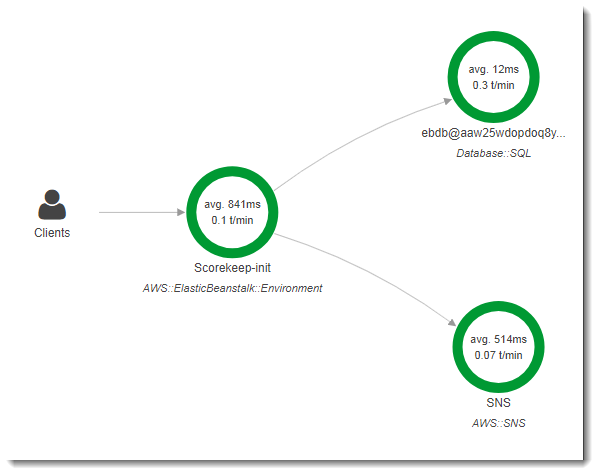
The default WebConfig class creates an Amazon SNS subscription for notifications. To
provide a segment for the X-Ray SDK to write to when the Amazon SNS client is used, Scorekeep calls
beginSegment and endSegment on the global recorder.
Example src/main/java/scorekeep/WebConfig.java
AWSXRay.beginSegment("Scorekeep-init");
if ( System.getenv("NOTIFICATION_EMAIL") != null ){
  try { Sns.createSubscription(); }
  catch (Exception e ) {
    logger.warn("Failed to create subscription for email "+  System.getenv("NOTIFICATION_EMAIL"));
  }
}
AWSXRay.endSegment();
In RdsWebConfig, which Scorekeep uses when an Amazon RDS database is connected, the
configuration also creates a segment for the SQL client that Hibernate uses when it applies the
database schema during startup.
Example src/main/java/scorekeep/RdsWebConfig.java
@PostConstruct
public void schemaExport() {
  EntityManagerFactoryImpl entityManagerFactoryImpl = (EntityManagerFactoryImpl) localContainerEntityManagerFactoryBean.getNativeEntityManagerFactory();
  SessionFactoryImplementor sessionFactoryImplementor = entityManagerFactoryImpl.getSessionFactory();
  StandardServiceRegistry standardServiceRegistry = sessionFactoryImplementor.getSessionFactoryOptions().getServiceRegistry();
  MetadataSources metadataSources = new MetadataSources(new BootstrapServiceRegistryBuilder().build());
  metadataSources.addAnnotatedClass(GameHistory.class);
  MetadataImplementor metadataImplementor = (MetadataImplementor) metadataSources.buildMetadata(standardServiceRegistry);
  SchemaExport schemaExport = new SchemaExport(standardServiceRegistry, metadataImplementor);

  AWSXRay.beginSegment("Scorekeep-init");
  schemaExport.create(true, true);
  AWSXRay.endSegment();
}
SchemaExport runs automatically and uses an SQL client. Since the client is
instrumented, Scorekeep must override the default implementation and provide a segment for the
SDK to use when the client is invoked.