View a key policies
You can view the key policy for an Amazon KMS customer managed key or an Amazon managed key in your account by using the Amazon KMS console or the GetKeyPolicy operation in the Amazon KMS API. You cannot use these techniques to view the key policy of a KMS key in a different Amazon Web Services account.
Every KMS key has a default key policy. A customer managed key that you share through
Amazon Resource Access Manager (Amazon RAM) also has an AWS_RAM key policy, which Amazon RAM creates and manages. You can
view the AWS_RAM key policy, but you can't change it. For more information about the AWS_RAM key policy, see How managed permissions are shown in KMS keys.
To learn more about Amazon KMS key policies, see Key policies in Amazon KMS. To learn how to determine which users and roles have access to a KMS key, see Determining access to Amazon KMS keys.
Authorized users can view the key policy for an Amazon managed key or a customer managed key on the Key policy tab of the Amazon Web Services Management Console.
To view the key policy for a KMS key in the Amazon Web Services Management Console, you must have kms:ListAliases, kms:DescribeKey, and kms:GetKeyPolicy permissions.
-
Sign in to the Amazon Web Services Management Console and open the Amazon Key Management Service (Amazon KMS) console at https://console.amazonaws.cn/kms
. -
To change the Amazon Web Services Region, use the Region selector in the upper-right corner of the page.
-
To view the keys in your account that Amazon creates and manages for you, in the navigation pane, choose Amazon managed keys. To view the keys in your account that you create and manage, in the navigation pane choose Customer managed keys.
-
In the list of KMS keys, choose the alias or key ID of the KMS key that you want to examine.
-
Choose the Key policy tab.
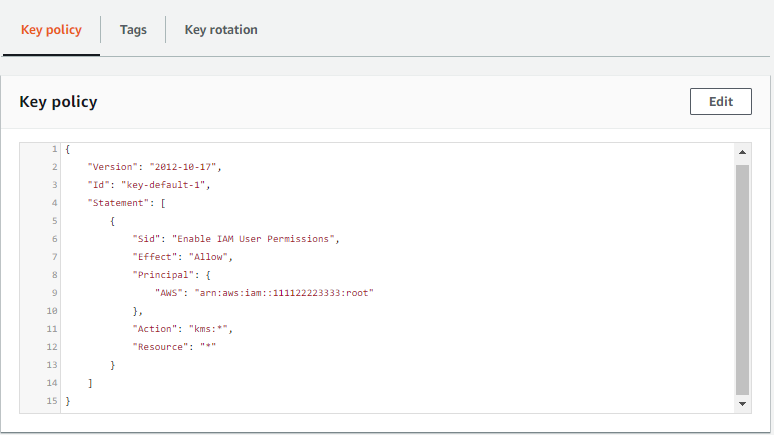
On the Key policy tab, you might see the key policy document. This is policy view. In the key policy statements, you can see the principals who have been given access to the KMS key by the key policy, and you can see the actions they can perform.
The following example shows the policy view for the default key policy.
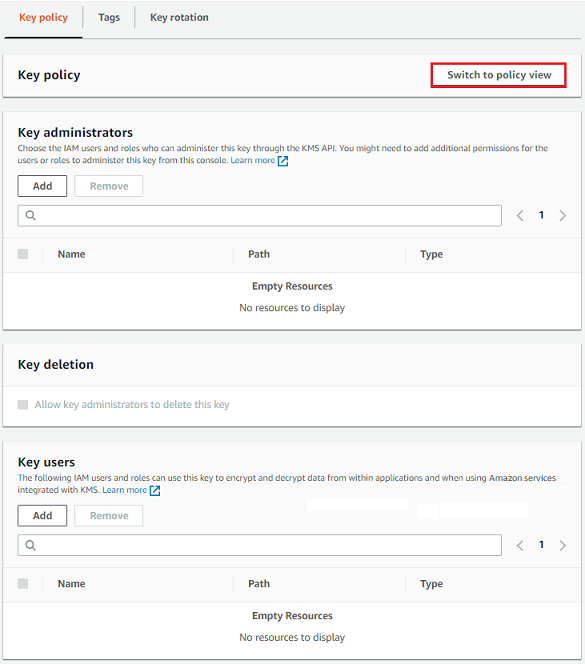
Or, if you created the KMS key in the Amazon Web Services Management Console, you will see the default view with sections for Key administrators, Key deletion, and Key Users. To see the key policy document, choose Switch to policy view. If the Key policy tab shows a Default view and Policy view (JSON) control instead, choose Policy view (JSON).
The following example shows the default view for the default key policy.
-
(Optional) To view the
AWS_RAMkey policy of a customer managed key that you share through Amazon RAM, choose the Resource shares tab, and then choose Policy view (JSON).The Key policy tab shows only the
defaultkey policy. The Resource shares tab lists the resource shares for the KMS key, and its Policy view (JSON) shows theAWS_RAMkey policy. The KMS key is in each resource share with a Resource status of Associated. You can't edit theAWS_RAMkey policy in the console. If the Resource shares tab shows No resource shares, the KMS key isn't in a resource share.To list the resource shares, you also need
ram:GetResourceShareAssociationspermission. Without it, the Resource shares tab shows Not authorized, but you can still choose Policy view (JSON) to view theAWS_RAMkey policy.
To get the key policy for a KMS key in your Amazon Web Services account, use the GetKeyPolicy operation in the Amazon KMS API. You cannot use this operation to view a key policy in a different account.
The following example uses the get-key-policy command in the Amazon Command Line Interface (Amazon CLI), but you can use any Amazon SDK to make this request.
The valid values of the PolicyName parameter are default
and AWS_RAM. If you omit PolicyName,
GetKeyPolicy returns the default key policy. The
--query Policy and --output text parameters return
only the key policy document, rather than a JSON object that contains it, to make
it easier to view.
Before running this command, replace the example key ID with a valid one from your account.
$aws kms get-key-policy --key-id1234abcd-12ab-34cd-56ef-1234567890ab--policy-name default --query Policy --output text
The response should be similar to the following one, which returns the default key policy.
To find out whether a KMS key has an AWS_RAM key policy, use the
list-key-policies
command. It returns default and, when the KMS key has one,
AWS_RAM.
$aws kms list-key-policies --key-id1234abcd-12ab-34cd-56ef-1234567890ab
Replace the following value:
-
1234abcd-12ab-34cd-56ef-1234567890ab
For a KMS key that you share through Amazon RAM, the output shows both key policies.
{
    "PolicyNames": [
        "AWS_RAM",
        "default"
    ]
}
To view the AWS_RAM key policy, set the --policy-name
parameter to AWS_RAM. If the KMS key doesn't have an
AWS_RAM key policy, GetKeyPolicy returns a
NotFoundException with the message No such policy
exists. For an example of an AWS_RAM key policy, see How managed permissions are shown in KMS keys.
$aws kms get-key-policy --key-id1234abcd-12ab-34cd-56ef-1234567890ab--policy-name AWS_RAM --query Policy --output text
Replace the following value:
-
1234abcd-12ab-34cd-56ef-1234567890ab